%20(250%20x%20100%20px).png)




Link exchanges currently hold a strange position in SEO. While Google advises against them, Ahrefs has discovered that nearly 74% of websites with some traffic have exchanged links coming back to them. So, the question is: are most sites violating Google's policy, or does its statement need further clarification?
The answer lies somewhere in between. Having carried out link exchanges for our SaaS link building agency for roughly 300 campaigns over the last 18 months, I would like to discuss the aspects of successful link exchanges in 2026, their penalty risks, and some dark sides of this practice.
What Is a Link Exchange?
A link exchange is when two websites agree to link to each other to improve their backlink profiles. It's also called reciprocal linking, and in its simplest form, it looks like this:
- Site A links to Site B
- Site B links back to Site A
Firstly, it is essential to note the difference between natural reciprocal links and artificial link exchanges. When you make a relevant link to your friend's company on your website and then receive it back from him or her, that is a natural reciprocal link, which Google tolerates. However, when you contact 50 random people, asking them to participate in a link exchange, you create an artificial link exchange, and modern spam classifiers are becoming more advanced.
The Types of Link Exchanges
There are five types of link exchanges you'll encounter in 2026. I'll rank them by the risk factor based on what we've seen across our campaigns.
Direct Link Exchange
Two websites simply agree to link to each other - you link to website A, and website A links back to you.
The problem is, Google knows this trick well. Two sites pointing at each other for no real reason is one of the oldest schemes in the book, and it's actively flagged as a link scheme in their guidelines.
Verdict: High risk.
ABC Link Exchange (Three-way Link Exchange)
Three sites form a triangle - B links to C, C links back to A (sometimes, A also links to B); so no two sites appear to exchange links directly.
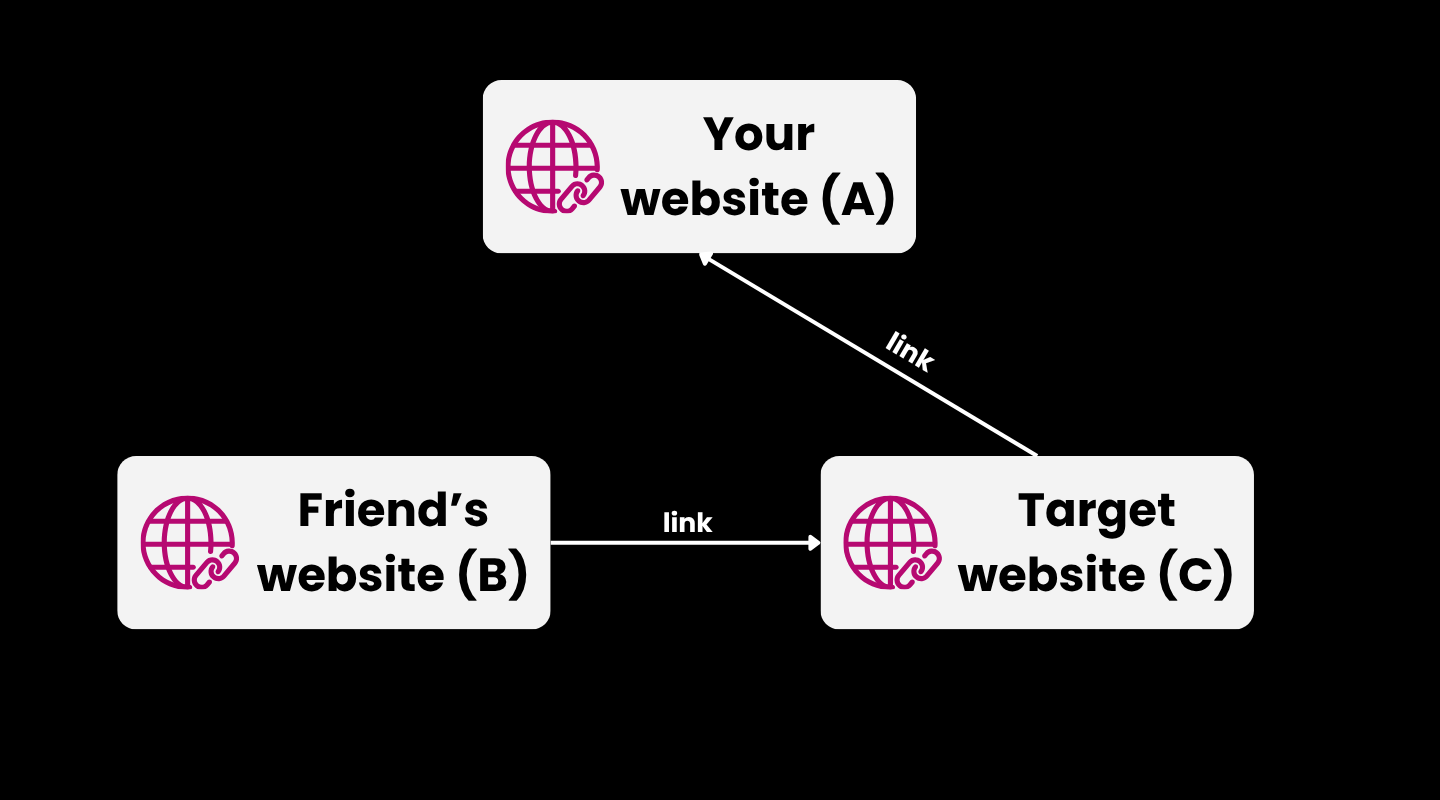
In practice, when all three link to each other (meaning B also links back to A), Google's algorithms spot it faster, especially when it's happening across many sites at once. When not, the risks are lower.
Verdict: Low-medium risk.
Guest Post Swaps
You write a post for my site with a link to yours, and I write one for your site with a link to mine. If it’s done occasionally between genuinely relevant sites, it's relatively manageable. Done repeatedly or at scale, it becomes an obvious pattern.
Verdict: Medium risk (context and frequency matter a lot here).
Collaborative Content Creation
A group of sites works together on something useful like a study, a report, or even a tool, and all naturally reference each other's contributions. Because there's real value behind it, any links that come out of it look (and are) legitimate. This is the one approach on this list that holds up well over time.
Verdict: Low risk.
Private Influencer Networks (PINs)
Someone controls a bunch of websites behind the scenes (different brand names, different hosting providers) and uses them to funnel links to one target site. It looks like an independent endorsement, but it's manufactured.
Google calls this a PBN (private blog network), and it's one of the most penalized tactics out there. Sites can get completely deindexed.
Verdict: Very high risk.
Google’s Policies on Link Exchanges
Google's position is pretty simple: a link should be a genuine recommendation. Their Spam Policies for Google Web Search say that links are meant to be independent editorial endorsements - you link to something only because your readers would benefit from seeing it.
Google's AI (SpamBrain) explicitly flags and bans a few things as "link schemes":
- Excessive reciprocal linking - trading links purely for SEO with no real editorial reason
- Buying or selling links - including exchanging products or services in return for a link
- Network exchanges - indirect swaps designed to disguise the arrangement
- Keyword-stuffed anchor text - forcing exact-match phrases into links unnaturally
How Does Google Enforce Its Link Exchange Policies?
There are two outcomes when Google catches a link scheme.
The most common is algorithmic devaluation - the links are simply ignored and pass no ranking benefit, making the effort worthless.
In more serious cases, a manual reviewer steps in, and the site takes a significant ranking drop or gets removed from search results entirely until the links are cleaned up and a reconsideration request is submitted.
How To Do Link Exchanges without Getting Penalized?
Let’s start with who you do link exchanges with, not how you do it. The single biggest factor in whether a link exchange is safe is whether there's a real relationship behind it - a contact you've worked with or a podcast host you've appeared with.
Find the Right Link Exchange Partners
In my experience, three methods that produce genuinely relevant candidates:
- Competitor backlink intersect - Run your top competitors through Ahrefs' Link Intersect. Sites linking to all of them are already proven to be relevant to your space and open to linking out — a much warmer starting point than cold prospecting.
- Niche communities - Private Slack and Discord groups in your industry tend to have an informal exchange culture with better quality control than random outreach.
- Existing relationships - Podcast hosts you've appeared with, editors you've written guest posts for, customers with relevant blogs. The relationship already exists; the exchange is just a natural extension of it.
Evaluate the Partner Website
Before agreeing to partner, check these:
- Is the linking page actually relevant? Domain authority means little if the page linking to you is about something completely unrelated to your business.
- Does the site get real traffic? 5,000+ monthly visits to the domain is a reasonable floor. Traffic to the specific page is better signal.
- What's the outbound link ratio? A site with 100 inbound and 600 outbound links is functioning more like a link farm than an editorial site.
- Is the content written for humans? Real authors, real editorial standards, content that occasionally exists for reasons other than link building.
- Do you actually know this person? A cold email proposing a swap is the weakest possible foundation for an exchange.
Link Exchange Execution Without a Footprint
Keep the volume low. Link exchanges should stay under roughly 10% of your total referring domains. Past that threshold, the pattern itself becomes a signal.
Space things out. Two mutual links appearing in the same week looks coordinated. The same two appearing two months apart does not.
Watch your anchor text. Exact-match anchors on reciprocal links look unnatural. Branded and partial-match is what real editorial links look like.
Avoid clusters. If you're exchanging with five sites that all exchange with each other, you're inside a network whether you meant to be or not.
No footer or sitewide links. Google devalued these long ago. They add risk with no real benefit.
Keep a record. Real emails, real conversations, real context. If a manual action ever lands on your site, you want to show this was a genuine relationship, not a transaction.
Better Alternatives to Link Exchange in 2026
Link exchanges are one of the link building tactics out there. They shouldn't be your main strategy. There are a few approaches that consistently outperform exchanges in our campaigns:
- Digital PR with proprietary data
- Podcast guesting and linking back to your site
- Unlinked brand mention reclamation
- Listicle link building
- HARO replacements (Qwoted, Featured, Help A B2B Writer)
- Generative Engine Optimization (GEO)
I've written about these in more detail in our link building strategies guide.
Final Thoughts
Link exchanges are not dead, nor are they risky per se. The risk comes when you view link exchanges as the sole method you can employ. You can employ any of the five link exchanges types we talked about, provided you abide by the ethics of link exchanges I outlined.
For professional advice in your particular situation concerning link exchanges or link building, please contact us, and we will offer you a custom proposal for free.
FAQ
Are link exchanges against Google's guidelines?
Excessive ones are. Google's policy specifically calls out "excessive link exchanges" and "partner pages exclusively for the sake of cross-linking." Natural reciprocal linking between relevant sites isn't penalized.
How many link exchanges is too many?
As a rough rule, keep them under 10% of your total referring domains. Past that, the footprint starts to dominate your profile and the risk outweighs the benefit.
Do nofollow link exchanges count?
Less so for SEO impact, and less so for Google's penalty calculation. A nofollow exchange is mostly a referral traffic play, not a ranking play.
Are three-way exchanges safer than direct ones?
Generally yes, because the reciprocation isn't visible in a single Ahrefs lookup. But Google's pattern detection has improved, and obvious three-way networks still get flagged.
Can a link exchange get my site penalized?
A single exchange almost never will. A pattern of them, especially with low-quality partners or in obvious networks, absolutely can. Manual actions for link schemes still happen in 2026, particularly for sites that rely on them heavily.