%20(250%20x%20100%20px).png)




Yes, but not in all cases. Your site’s ability to rank without links is conditional upon two factors - the competitiveness of your target keywords and the quality of your content.
Here we discuss when exactly you could do it, which tactics help in that and how high the bar is set.
When Can't & Can You Rank Without Backlinks
Before getting into tactics, here's a framing for you:
This table should save you a lot of wasted effort. Backlink-free SEO is a real strategy, but it has a ceiling. I'll tell you exactly where that ceiling is at the end of this guide.
7 Strategies To Rank Without Backlinks
Let me show how can you rank without backlinks using tested strategies.
1. Target Long-Tail, Low-Competition Keywords, & Cluster Them
This is the foundation of ranking without backlinks. High-volume head terms like "project management software" have entrenched DR 65+ competitors with thousands of referring domains.
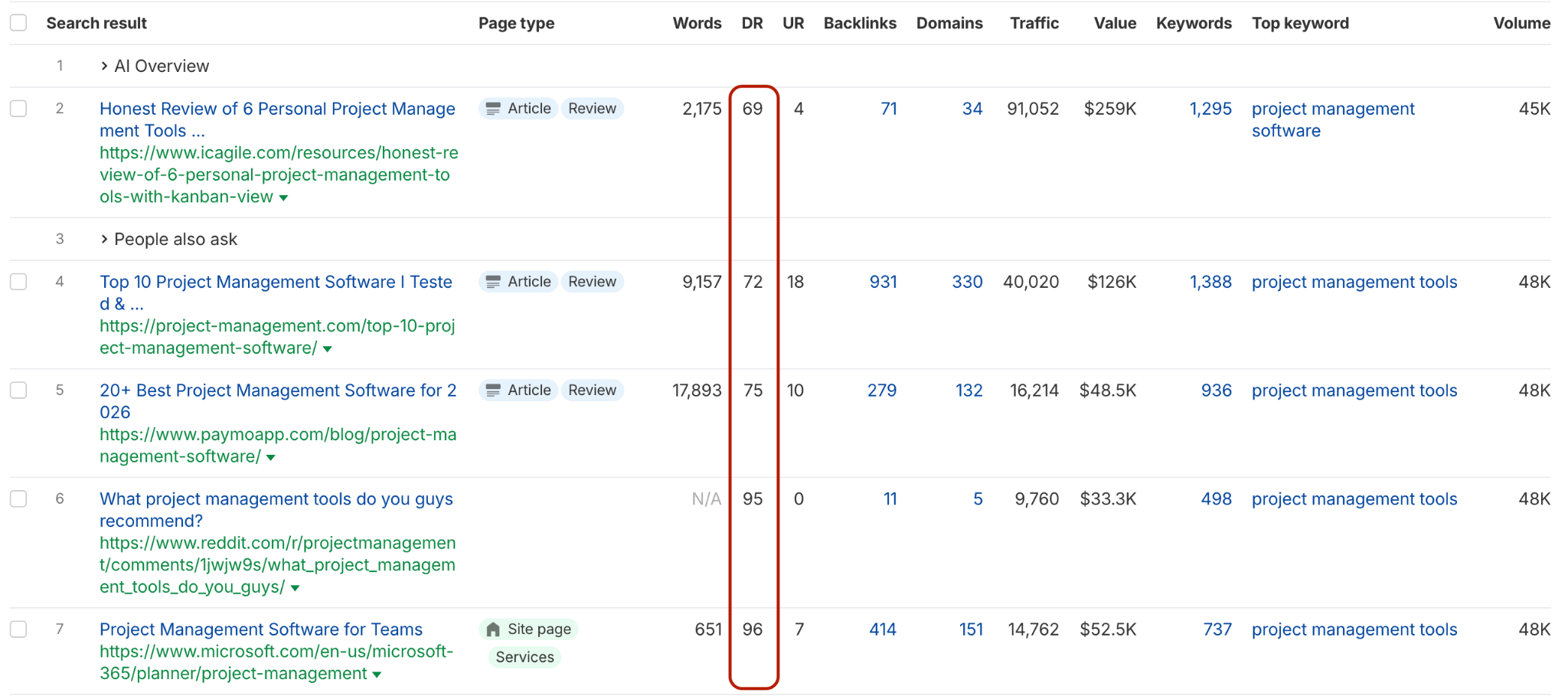
You won't beat them without links. But "project management software for remote construction teams," that's a different fight.
How to find these keywords:
- Open Semrush's Keyword Magic Tool or Ahrefs Keywords Explorer
- Go the the Related Terms tab & enter your broad topic
- Filter to KD ≤ 20 (or "Easy" / "Very Easy" in Semrush)
- Filter by search intent (prioritize informational and commercial investigation queries first)
- Look for keywords with 50-500 monthly searches. Ignore anything labeled "low volume" if the intent is strong - 80 searches/month from the right buyer beats 2,000 from someone just browsing
Use the clustering approach!
Don't just write one article per keyword. Build 8-15 tightly related pieces around a single topic. Google doesn't just evaluate individual pages anymore, it evaluates how deeply a site covers a subject. A site with 12 pieces on "HR software for small businesses" signals expertise in a way a single article never can.
Expert Recommendation from Our Team:
Use Google's People Also Ask box and AlsoAsked.com to find every sub-question around your target keyword. Each question is a potential page. Each page ranks independently and passes authority back to your pillar through internal links (more on that in strategy 3).
2. Build Topical Authority - Go Deep, Not Wide
Topical authority is what happens when Google trusts your site as the go-to resource on a specific subject.
A brand-new site with 30 tightly-focused articles on HVAC maintenance can outrank a high-DA site with 5 scattered articles on the same topic.
How to build it:
- Pick one niche and commit. Don't publish about five different topics while you're small - the signal is diluted
- Cover the full topic map: beginner explainers, advanced guides, comparisons, tool roundups, how-tos, case studies
- Use consistent terminology across your content so Google can map the semantic relationships
- Aim for ~20-30 published pieces before expecting significant cross-page lift
Expert Recommendation from Our Team:
The threshold I see in practice: somewhere around 15-25 highly relevant, well-optimized pieces in a defined topic area, sites start ranking for terms they haven't even directly targeted. That's topical authority working.
This is especially powerful for SaaS companies in specific verticals. A workforce management SaaS that publishes 25 pieces on construction HR regulations, shift scheduling law, and labor compliance will own that topic space before a larger generalist competitor even notices.
3. Use Internal Links the Way Most Sites Use Backlinks
This is mentioned a lot, but rarely explained well enough.
Here's the mechanism: when a page on your site ranks and receives clicks, it accumulates authority. If you link from that ranking page to a harder-to-rank target page, you're passing that authority internally. Do this systematically across 10-15 easy-to-rank pages all pointing at your competitive target, and you've built an internal link equity funnel.
In practice:
- Identify your "easy win" pages - low-KD keywords you're already ranking for, or targeting
- Identify your priority target page - the one with real business intent
- From every relevant easy-win page, add a contextual internal link to the target page
- Use varied anchor text – from exact match, partial match, and natural variations (our software, this tool, contract management platform)
- Ensure access to priority pages in two or three clicks from your home page.
In numerical terms: if you have 12 ranking pages linking to your target page and each of those pages has over 20 clicks per month, it means you've got authority on your target page that isn't backed by any other external link.
Expert Recommendation from Our Team:
The anchor text variation is important. Over-optimizing with exact match anchors across all 12 internal links looks unnatural. Treat internal link building with the same intentionality as external, because it works almost as well when done at scale.
4. Do On-Page SEO Basics Better Than Your Competitors
On-page matters more when you have no backlinks because it's the only other lever you control. The basics everyone knows are keywords in title, H1, URL, meta description, first 100 words, but that’s not enough.
Go beyond keyword placement:
- Semantic coverage: Use a tool like Clearscope or Surfer to identify related terms and entities Google expects to see in a thorough treatment of your topic. A post about "remote work software" that never mentions "asynchronous communication" or "time zone management" is signaling thin coverage
- EEAT signals: For competitive queries, Google evaluates expertise. This means: named author with credentials in the bio, original data or firsthand experience in the content, citations from authoritative sources, and clear methodology when making claims
- Answer the query directly, fast: Put the core answer in the first paragraph or a TL;DR box. Don't make the reader scroll through 400 words of preamble. This improves dwell time and directly impacts CTR from AI overviews
- Content depth vs. word count: Longer isn't better - more complete is better. A 1,200-word article that answers every sub-question is much better than a 3,000-word article that repeats the same point six times.
Expert Recommendation from Our Team:
A practical method for this is to take the top 3 competitors for your target keyword, run them through Clearscope or manually check their headers. Find the subtopics they cover lightly or miss entirely. Build your article around those gaps.
5. Start with Local SEO
If you're a local business, or a SaaS targeting specific geographic markets, this is the clearest path to ranking without backlinks. Local search operates on different signals than organic search.
What actually drives local rankings:
- Google Business Profile - Completeness, accurate business category selection, timely photos updates, active Q&A session engagement, active posting – all these factors affect your business's rating on Maps.
- Review velocity & sentiment – not only the quantity but how many reviews you're getting at the moment and what keywords they include. Your customer uses the phrase "the best HVAC repair in Austin" – you receive a natural keyword signal.
- Citation consistency – the exact match of your name, address, phone numbers on all directories. Your NAP must be the same on Google Business, Yelp, Apple Maps, industry directories, and local chambers of commerce.
- Local landing pages – if your services are provided to several locations, an optimized landing page for "HVAC repair in [city]". It may easily outrank any other page with zero backlinks on mid-size location pages.
Expert Recommendation from Our Team:
For SaaS companies with regional focus (like a compliance tool for California healthcare, for example) local and niche-specific signals work similarly. Targeted, specific, low competition, even before you do anything like SaaS listicle link building or strategies like SaaS niche edits.
6. Do CTR Optimization to Signal Relevance
Google pays attention to whether people click your result and stay. A page that earns a higher-than-expected CTR for its position gets a rankings boost. A page where people immediately bounce gets pushed down.
How to improve CTR without changing your content:
- Title tag: Include the target keyword near the front. Use a number if there is one ("7 strategies", "3 mistakes"). Ask a question if the keyword is a question. Test emotional triggers ("the honest answer", "what nobody tells you") - these work in certain niches
- Meta description: Write it as a value proposition, not a summary. "Discover the 7 SEO strategies that ranked our site to 3.9M clicks without link building" converts better than "In this article, we discuss SEO strategies"
- Rich snippets: Add FAQ schema, How-To schema, or Review schema where appropriate. A result that shows an expanded snippet takes more screen real estate and earns more clicks even at the same position
- Page speed: A slow page doesn't just hurt rankings - it kills the engagement signal when people bounce before the page loads. Run PageSpeed Insights and fix the critical issues first
Expert Recommendation from Our Team:
Rand Fishkin's 2014 experiment showed that a coordinated spike in clicks moved a result from position #7 to #1 in a single day. While you can't replicate that artificially, the underlying signal is real: organic CTR improvements from better titles and meta descriptions do move rankings.
So, start optimizing your meta information.
7. Use Original Research and Unlinked Citations
This one takes more upfront investment but compounds well.
When you publish original data like a survey, an industry benchmark report, an analysis of your own dataset, other sites reference it. Sometimes with a link, often without. Even unlinked mentions of your brand and URL are a signal Google has confirmed it processes.
It’s is called a linkable asset, and this is how it works:
- Annual industry surveys (even with a small sample like 150-200 respondents via LinkedIn or your email list is enough to produce citable data)
- Analysis of publicly available data that nobody has framed clearly yet
- Original case studies with real numbers (conversion rates, traffic growth, cost per acquisition)
- Benchmark reports for a specific niche
Expert Recommendation from Our Team:
For SaaS and targeted niches specifically, your product data is an asset. Anonymized aggregate insights from your user base are things no competitor can replicate. A "State of [Your Niche] Report" built from your own data is both a link magnet when you do pursue links and a topical authority signal when you don't.
We’ve proved that this works in various SaaS-specific case studies and experiences with our clients.
The Ceiling - When You'll Need Backlinks
I run a SaaS link building agency, so you might think I'm not neutral here, but I'll give you the honest version.
For most SaaS companies and similar competitive markets, the backlink-free approach works as the initial foundation, but not a full strategy. You use it to:
- Build topical authority early without a link budget
- Generate initial traffic and engagement data
- Identify which pages and topics convert, so when you do invest in links, you're investing in the right pages
Once you want to rank for keywords with KD 35+, compete in a space with established players, or accelerate growth beyond what content alone can deliver, backlinks become necessary.
The ceiling for organic-only SEO is roughly:
- Informational keywords: Can often rank to KD 30-35 without backlinks if topical authority is strong
- Commercial / comparison keywords: KD 20-25 is a realistic limit without links
- Transactional / high-intent SaaS keywords: Almost always require backlinks above KD 20
At that point, the question is how to do white hat link building in a way that's sustainable and targeted.
If you want to understand how this transition looks in practice, our SaaS link building strategies guide covers the full approach.
Final Answer: Can You Rank Without Backlinks?
First of all, it makes sense to apply backlinkless SEO tactics as a base to generate traffic, topical authority and conversion data, and later combine those efforts with a systematic link building process when identifying the best performing pages.
So, can you rank without backlinks? Yes, if you pick the right keywords, build genuine topical depth, and treat internal linking as seriously as most sites treat external links.
Will it work forever? No.
So, if you are a SaaS business, are at that second stage and want to understand what link building looks like for you, reach out to us and we’ll help you.
Frequently Asked Questions
How long does it take to rank without backlinks?
Low-competition long-tail keywords (KD<20) allow you to start ranking in 4 to 12 weeks after publishing properly optimized content. It will take 6 to 12 months of regular publishing to get significant traffic (500-1500 uniques per month).
Do backlinks still matter for SEO in 2026?
Yes, significantly. Google has reduced their weight somewhat in low-competition spaces (hence why ranking without them is possible there), but for anything with real commercial intent and established competition, backlinks remain a primary ranking factor. They're not going away.
Can you rank without backlinks for competitive keywords?
Rarely. Highly competitive industries such as SaaS, finance, e-commerce and healthcare have the majority of top-ranking pages which have strong backlinks. There's one exception to this rule – highly competitive keywords with a poor SERP (poor quality pages and content) where an exceptionally high topical authority might work. But this is the exception, not something to plan around.
Is local SEO possible without backlinks?
Yes, local is the clearest case where backlinks are largely optional. Google Maps rankings depend primarily on proximity, relevance, and prominence (reviews + citations), not external backlinks.
Should you buy backlinks in 2026?
When you move to the stage of link building after avoiding it for a while, you might be tempted to buy backlinks. I would advise deeply against it, if you are opting for link farms and bulk purchases. It will work against all the effort you put in your site prior.