%20(250%20x%20100%20px).png)




Link building matters in 2026, both for Google rankings and for getting cited in AI search results like ChatGPT and Perplexity. But how you build those backlinks matters more than ever.
This guide walks you through white hat link building as the right way to build backlinks: what it means, what makes a backlink worth chasing, which tactics work right now, and how to run a campaign that compounds over time instead of getting you penalized.
I'm writing this from the perspective of someone who builds links for SaaS companies every day, so expect practical advice over theory.
What Is White Hat Link Building?
White hat link building is the practice of earning backlinks through ethical methods that comply with Google's spam policies. Instead of buying,manufacturing or exchanging links, you earn them by creating something worth linking to and putting it in front of the right people.
Three principles define white hat link building:
- Relevance - links come from sites topically or geographically related to yours
- Value - the link exists because your content genuinely helps the linker's audience
- Transparency - you'd be comfortable showing your link acquisition process to a Google employee
That last one is the most important test - if you'd hide it from Google, it's not white hat.
White Hat vs. Gray Hat vs. Black Hat Link Building
Here's how to think about each of these three methods:
Most real-world link building programs sit at "mostly white hat with some gray." That's fine. Just make sure you understand which is which, and don't let gray tactics dominate your backlink profile.
Why Does White Hat Link Building Still Work in 2026?
Google's algorithm has gotten dramatically better at ignoring or punishing manipulative links. The 2024 spam updates and SpamBrain improvements mean that low-quality links are increasingly being neutralized. That means that they don't help, don't always hurt either; they just become invisible.
But white hat link building still works for:
- Traditional SEO - Google's link spam systems reward links that look natural - earned, contextual, and from sites with real audiences.
- AI search - ChatGPT, Perplexity, and Google's AI Overviews lean on citation-worthy sources. Sites that are linked from trusted publications and resource hubs are more often pulled into AI answers. This is a major reason GEO (generative engine optimization) for SaaS overlaps so heavily with traditional link building - the signals are converging.
So, white hat link building is the best way to become a source that both Google and LLMs cite.
What Makes a Backlink White Label and High Quality?
I’ll talk about white hat link building strategies below, but before chasing a link with any of these methods, run it through these criteria:
- Relevance - A link from a site in your industry outweighs one from an unrelated site with higher authority. For SaaS, that means marketing blogs, SaaS publications, and tools-focused content, not a generic news site that happens to have high DR.
- Domain Authority - DR (Ahrefs) and DA (Moz) are useful proxies for link equity, but don't chase them at the expense of relevance. A DR 45 SaaS blog usually beats a DR 80 unrelated site.
- Page-Level Traffic - A page Google doesn't rank isn't one it values. Always check the linking page's traffic, not just the domain's.
- Editorial Placement - A link inside the article body, in context, is worth more than one in a sidebar, footer, or author bio. Search engines are good at telling these apart.
- Anchor Text - Keep it natural. Heavy use of exact-match commercial anchors is a clear spam signal. Mix branded, partial-match, generic ("this guide"), and naked URL anchors.
- Dofollow vs. Nofollow - Dofollow links pass equity; nofollow links don't (directly). But nofollow links from major publications still bring referral traffic and get cited by other writers who may link back with dofollow.
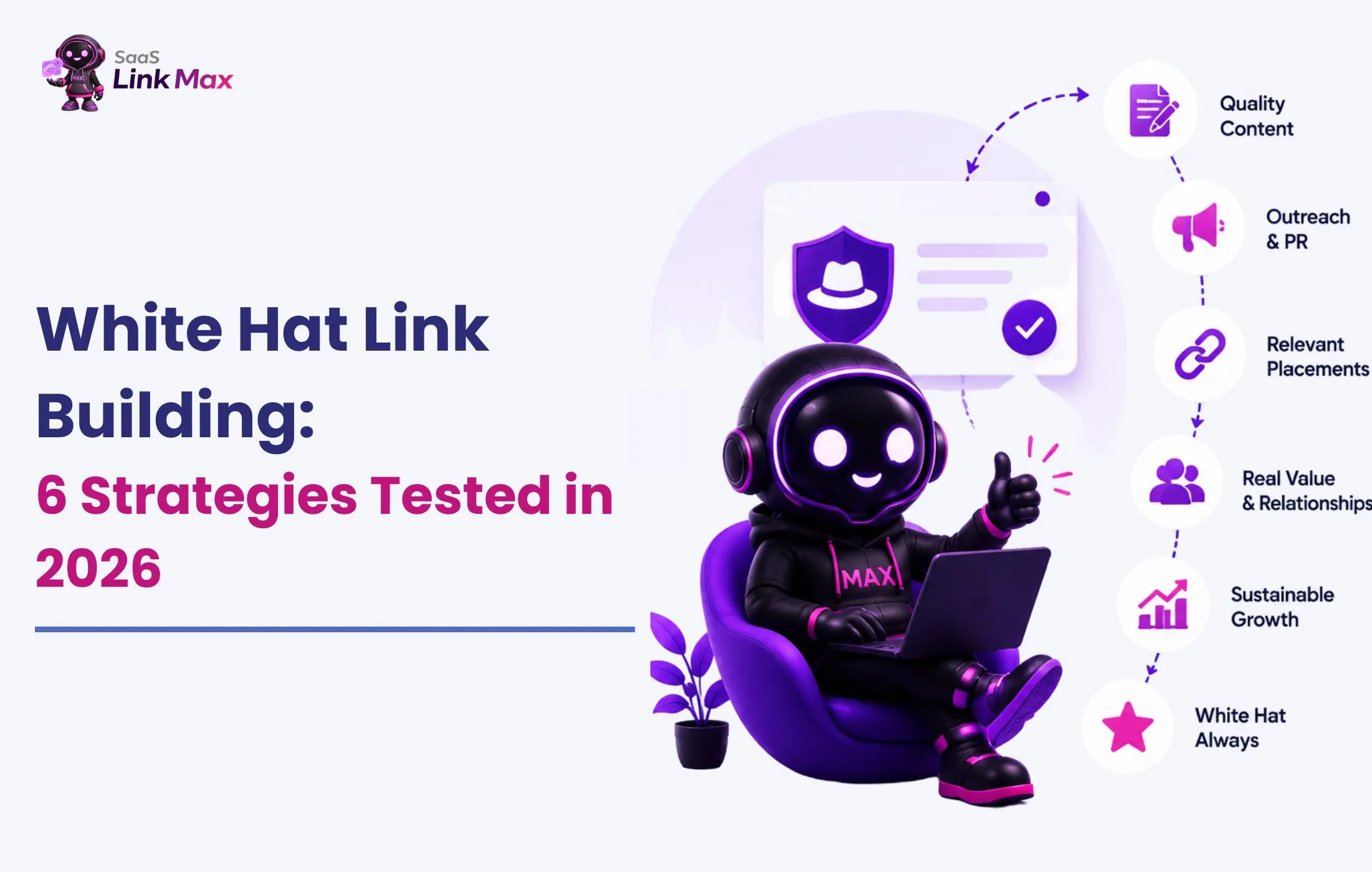
6 White Hat Link Building Strategies (Tested in 2026)
These are the nine that consistently produce results for all types of business and niches.
1. Linkable Assets
A linkable asset is content people genuinely want to reference: free tools, calculators, comprehensive guides, templates, original research.
The best ones solve a real problem. A SaaS pricing calculator, a churn benchmark report, a data study journalists keep citing two years later - these earn links passively because nothing else quite replaces them.
If you don’t have original data, you could run a survey through OnePoll, YouGov, or Pollfish, or dig into public datasets and package the findings into something readable. The data doesn't have to be yours, it just has to be useful and well-presented.
That’s why, for example, statistics guides work. Even if you don’t have unique data, you interpret it uniquely and collect it in one spot, and it becomes a useful resource.
We created such a guide for one of our SaaS clients in the digital business cards niche (read the case study for more details), and got 103 organic links and 69+ referring domains in a couple months.
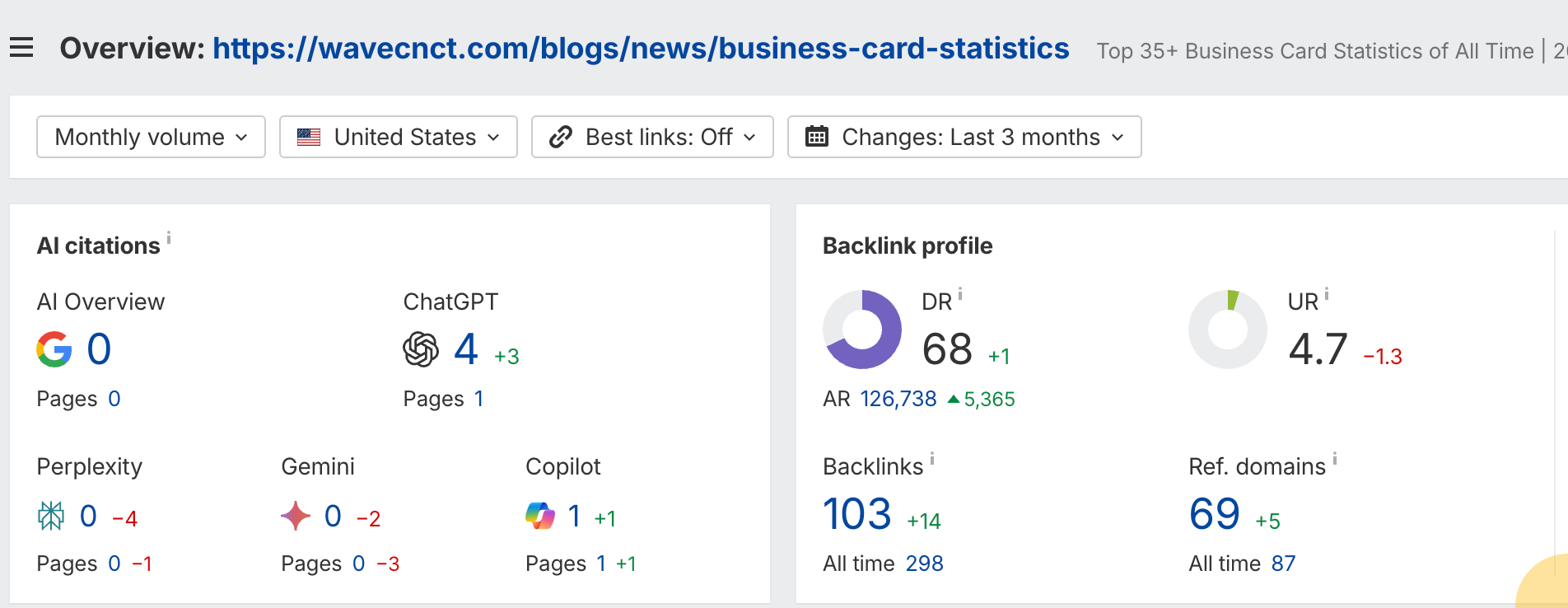
Before you start any outreach, audit what linkable assets you already have. If the answer is nothing, that's where you start.
2. Digital PR and Reactive Newsjacking
Digital PR is giving journalists something they need - original research they can cite, expert commentary that adds context, or a sharp take on something that just broke in your industry.
The reactive side (reactive PR/newsjacking) is where a lot of people sleep on the opportunity. When news breaks, journalists are on deadline and looking for sources fast. If you can get them a useful quote or a relevant data point quickly, you become part of the story. Speed matters more than polish here.
The difference between digital PR and traditional link building is worth understanding - I've covered it in more detail in digital PR vs link building.
3. Strategic Guest Posting
Guest posting still works when done right. The problems start when people treat it as "publish anywhere with a link."
Good guest posting means:
- Writing for sites your audience actually reads
- Contributing genuinely useful content (not 800 words of fluff)
- Earning a contextual link inside the article, not just a bio link
- Choosing sites with real editorial standards
Skip sites that publish anything, list "Admin" as the author, or charge $50 per post with no review. These are gray hat at best, and are quite risky specifically for niches like finances, SaaS, and others. Quality guest posting for SaaS is harder, slower, and significantly more effective.
4. Broken Link Building
Find broken links on relevant pages, then offer your content as a replacement. You're fixing their broken page, which is why response rates are much higher than cold outreach.
Tools like Ahrefs' broken link checker or the Check My Links Chrome extension can help you to look for resource pages and competitor backlinks first. Once you have that, you’ll find broken links clusters as well.
This works best when you already have content that closely matches what the broken link pointed to. If you have to create new content for every broken link, the math gets ugly fast.
5. Resource Page Link Building
Resource pages are curated lists of useful links on a specific topic, usually on educational sites, industry hubs, or associations. To get in them, you simply find the right pages, pitch something that belongs there.
To find candidates, use search operators like "your topic" inurl:resources or "your topic" intitle:"resources". Takes about ten minutes to build a solid prospect list.
This works great for industries like SaaS. Pitching for inclusion in "Best SaaS X" or "Top Tools for Y" listicles is a close cousin and often more effective for product-led companies as a part of their listicle link building for SaaS.
6. Unlinked Brand Mention Reclamation
Someone mentioned your company, product, or founder without linking. You email them, thank them, and politely ask for a link.
Set up Google Alerts, Mention, or Brand24 to track mentions. Conversion rates on this outreach are usually far higher than cold pitching, because there's no convincing needed.
If you want to go deeper on the full execution side, our SaaS link building strategies guide covers the SaaS-specific playbook in detail.
The White Hat Link Building Process (Step-by-Step)
Your link building strategy will probably look like a mix of all tactics above. For any of these, to get started, you need to follow similar steps.
Step 1: Audit Your Existing Backlink Profile
Pull your current backlinks using backlink monitoring tools. You're looking for:
- Existing high-quality links (to thank, build relationships, and replicate)
- Toxic links (to disavow if necessary)
- Patterns in what already works for you
- Broken links
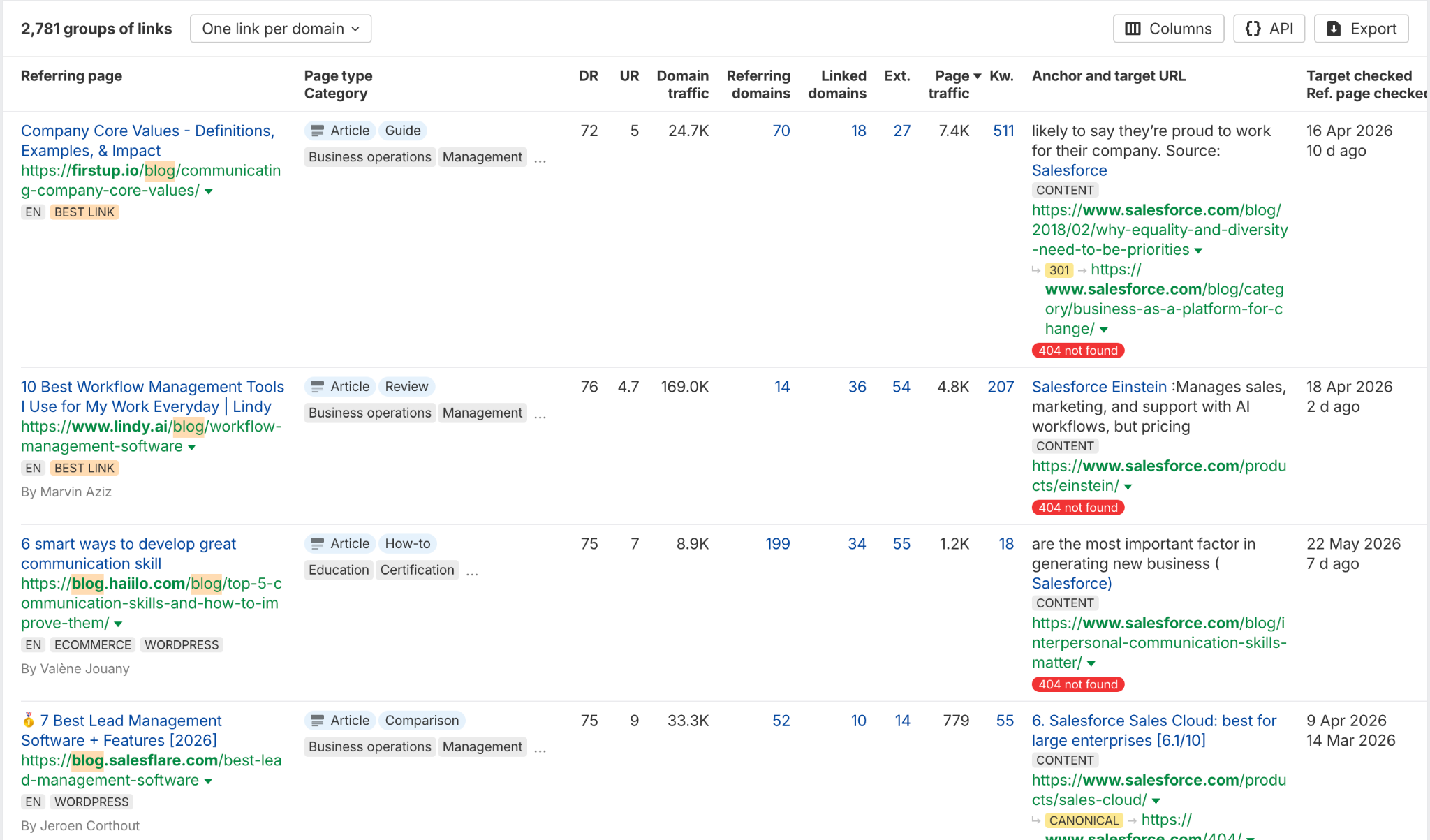
You'll almost always find quick wins, like outdated links to update, broken links pointing to you that need redirects (like on the screenshot), lost links to reclaim.
Step 2: Analyze Competitor Backlinks
Run your top 3-5 competitors through a backlink tool. Filter for dofollow, contextual links from relevant sites. These are your prospect list shortcuts. Some backlink monitoring tools have a competitor analysis feature that can be useful as well.
Look especially for sites linking to multiple competitors. If three of your competitors got links from the same blog, you almost certainly can too.
Step 3: Identify or Create a Linkable Asset
You can't build links to nothing. Either identify the strongest existing page on your site, or invest in creating something worth linking to before you start outreach.
For most SaaS companies, this is a guide, a tool, or original research.
Step 4: Build a Prospect List
For each tactic you're running, build a list of target sites with:
- URL
- Contact email or form
- Why they're a fit (briefly)
- Status (not contacted / contacted / responded / linked)
A simple spreadsheet works. The right link building tools can dramatically speed this up - BuzzStream, Pitchbox, Monitolink and Respona are the common choices.
Step 5: Personalize Outreach
Generic templates have terrible response rates now. Every email needs at least:
- A reference to something specific on their site (proves you read it)
- A clear, brief value proposition
- One ask, stated clearly
I'll cover this in more depth in the next section.
Step 6: Follow Up and Track
Most links come from the second or third email. One follow-up after 4-7 days, kept short and friendly, doubles response rates on average.
Track everything. Update your sheet after each send and reply. Patterns will emerge (certain pitch angles work better, certain site types are more receptive), and you'll get more efficient over time.
How to Write Outreach Emails That Get Replies
Here’s the anatomy of a good pitch, based on our SaaS link building company’s experience:
Subject line: Specific and intriguing, not generic. "Quick question about your [specific post]" beats "Link request."
Opener: One sentence proving you read their site. Reference a specific article, a recent point they made, or a project they shared. Never do the "I love your blog" line.
Value: What's in it for them? A genuinely useful resource, a fix to a broken link, data their audience will care about. State it in one or two sentences.
The ask: One clear request. "Would you consider adding it to [specific page]?" is better than vague hints.
Sign-off: Short, no over-explaining.
Here's a real example structure for a broken link pitch:
Subject: Broken link on your [post topic] page
Hi [Name],
Was reading your guide on [specific topic] this morning and noticed one of the resources you linked to (the [X] guide) is throwing a 404.
I run [Site], and we published a guide on the same topic last year that might work as a replacement: [link].
No pressure either way - figured you'd want to know about the broken link regardless.
Thanks, [Name]
The common mistakes that kill response rates:
- Asking for a link in the first sentence
- Vague flattery ("I love your content!")
- Sending the same template to everyone
- Hiding the ask behind 200 words of preamble
- Following up more than twice
Final Thoughts
White hat link building isn't complicated, but it is demanding. The principles are simple - be relevant, be valuable, be transparent. And the tactics are well-documented. What separates results from no results is consistency.
Build your strategy around 2-3 methods I have shared, run them for six months, and track to see what works.
If you are a SaaS company that needs advice before starting, contact our expert team, and our team will share a customized proposal with you.
Frequently Asked Questions
How long does white hat link building take to show results?
First signs (links landing, response rates settling) show up within 30-60 days. Real ranking and traffic movement takes 3-6 months and builds from there. Anyone promising faster is cutting corners somewhere.
How many backlinks do I need to rank?
No fixed number. You need more high-quality, relevant links than whoever's currently ranking for your target keywords. For competitive SaaS terms, that's often dozens to hundreds of referring domains to that specific page.
Can I do white hat link building without creating new content?
Mostly yes. Unlinked mention reclamation, HARO, podcast guesting, and broken link building can all run on existing content. That said, having at least one strong linkable asset makes almost every tactic more effective.
Is guest posting white hat or gray hat?
Depends how you do it. Earned placements on real, editorially-reviewed sites - white hat. Paid posts on low-quality sites that'll publish anything - gray hat.
How is white hat link building different from digital PR?
Digital PR is a subset - it goes after links from news outlets and high-authority media specifically. All ethical digital PR is white hat link building, but not the other way around.
Do nofollow links count as white hat backlinks?
Yes. They bring referral traffic, build brand visibility, and often get picked up by other writers who link back with dofollow. Google also treats nofollow as a hint now, not a hard stop.
How much does white hat link building cost?
In-house costs $4,000-$10,000/month for a link building specialist(s). So, if you don’t have a team already, agencies might be a better choice for you. They cost $3,000-$15,000/month depending on volume and target authority. Individual links through agencies typically run $200-$1,500 each (if paid).