%20(250%20x%20100%20px).png)




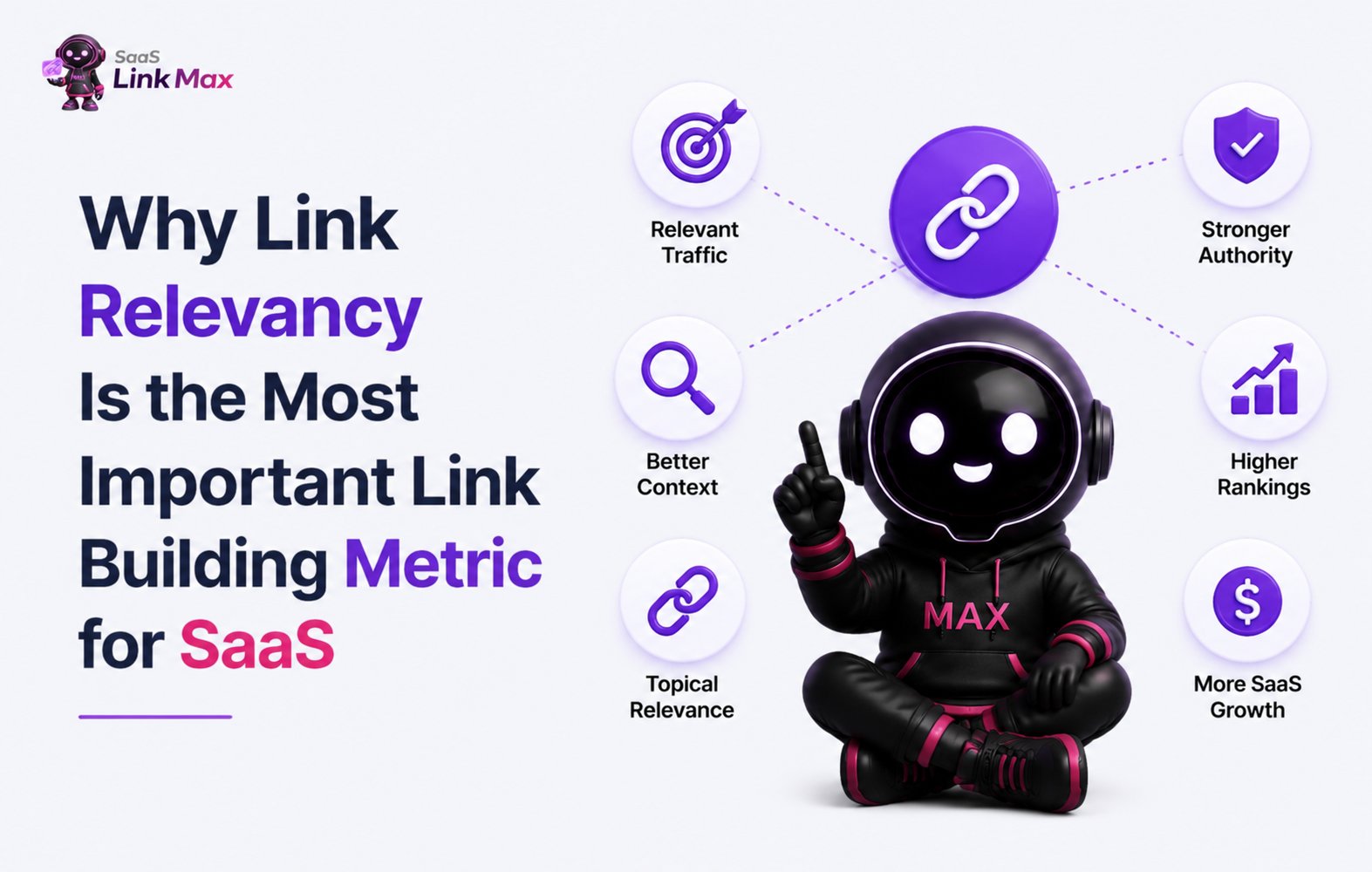
For SaaS link building, relevancy beats Domain Rating, backlink count, or site "tier." One link from a smaller, on-topic site usually helps your rankings, AI visibility, and pipeline more than one from a huge, unrelated domain.
That being said, below I’ll explain what relevancy means, why it matters more than other metrics, and how to judge a relevant link (by also avoiding mistakes).
What Link Relevancy Means
Link relevancy is a measure of how closely the content around a backlink - the page, the paragraph, the surrounding context - relates to your product's topic and audience.
It doesn't measure the whole site's category. This distinction matters because most link-building advice treats relevancy as a site-level label: "this is a marketing site," "this is a health site," "this is a SaaS site." In reality, relevancy is evaluated closer to the sentence and page level. A general business publication can carry a highly relevant link if the specific article is about your exact use case. A niche-sounding blog can carry a low-relevance link if the placement is forced into unrelated content.
The practical implication: don't rule out a site because it's not a "SaaS site" on its homepage. Rule it in or out based on whether the specific page you'd be linked from is about something your buyers care about.
At our SaaS link building agency, we evaluate every prospective placement this way before we pitch it - page-level topic match and page-level traffic. That single filter removes most of the uncertainties teams run into when building a SaaS link building strategy.
Why Relevancy Beats Domain Authority for SaaS
Domain Authority (or Domain Rating, depending on the tool) is a single number describing a whole website's general strength. It doesn't tell you whether that strength has anything to do with your topic, and it doesn't tell you whether the specific page linking to you has any authority of its own.
SaaS products are narrow by nature. You sell to a specific role, solving a specific problem, inside a specific workflow. So, no matter how impressive the number looks in your reporting, a high-DA link from a site that has nothing to do with that world passes very little useful signal.
Compare two scenarios:
- A DR 20 blog in your exact niche, read by the people who buy your product, linking to you from a page that already ranks and gets clicks.
- A DR 80 general news site, linking to you from a page buried in an unrelated section that gets almost no organic traffic.
The first link is doing real work: it's telling Google (and any AI system referencing that page) that your product is relevant to a specific topic, and it's putting your brand in front of people who are already looking for a solution like yours. The second link is mostly decorative. It looks good in a backlink report and does very little for rankings or pipeline.
If you're deciding between the two and all other factors are equal, take the relevant link.
Does Relevancy Drive Referral Traffic and Conversions?
Yes, but the mechanism is more specific than "relevant links convert better." A relevant link only helps if the page hosting it is visible in search and getting clicks. A backlink on a page nobody sees, about a topic nobody's searching for, won't bring traffic or build authority efficiently - no matter how well the topic matches on paper.
Before pursuing a link, check:
- Does the linking page rank for anything? Pull it through a rank tracker or a "search by URL" tool. If it has zero visible keywords, it's not sending referral traffic, and it's passing less authority than a page that does rank.
- Does the audience overlap with your ICP? A relevant topic with the wrong audience, like a consumer blog covering B2B software as a side note, won't convert even if it technically matches your keyword.
- Is the link placed in the body content? In-content links in the main body carry more weight and get more clicks than links in boilerplate sections like sidebars or footer.
One of our link builders at SaaSLink Max shared another criterion, which I found useful for you as well: "We check whether the linking page ranks before we ever pitch it. A relevant topic on a page nobody sees is just a relevant topic with no traffic behind it."
This is also why review platforms and industry resource sites tend to perform well for SaaS: the traffic is already pre-qualified.
How to Evaluate Relevancy Before You Pursue a Link
Use this as a working checklist before you commit outreach time or budget to a placement:
- Audience overlap. Does the site's readership resemble your ideal customer profile? A link from a site your buyers read is worth more than a link from a site with impressive traffic but a different audience.
- Page-level ranking and traffic. Check whether the specific page ranks for anything and pulls organic visits.
- Contextual integration. The link should be natural inside a sentence that adds value to the reader.
- Anchor text in context. Read the sentence the anchor sits in. If it reads naturally and describes what you do, it's a good sign. If it feels inserted, it probably will read that way to Google, too.
- Geographic relevance, if applicable. For location-dependent SaaS products, a link from a site with a relevant geographic audience carries extra weight.
None of this requires expensive tooling. A rank tracker, a backlink checker, and five minutes of reading the page will tell you more than a DA number ever will. If you want a repeatable process for your team, our SaaS link building checklist walks through the same evaluation steps in more detail.
The Myth of Sitewide Relevance
Many assume Google (or an LLM) judges relevance by site category - a "marketing SaaS" can only get good links from other marketing sites. That's not how it works. There's no manual sitewide categorization; it doesn't scale. Relevance is judged at the page and link-context level.
So don't limit outreach to your exact niche. A payroll SaaS can earn a real link from an HR blog or accounting site; a cybersecurity SaaS from a compliance publication, because the content context fits, even if the site label doesn't.
Same with partnerships: integration pages, co-marketing content, and joint case studies with real partners make natural, defensible link sources - the relationship is genuine.
Relevancy Strategies Built for SaaS
Once you're filtering for relevancy instead of raw authority, a few link-building approaches consistently perform well for SaaS specifically:
Integration and Partner Links
SaaS products rarely operate in isolation - most have a stack of tools they integrate with. Joint content, integration directories, and partner blog mentions are naturally relevant because the business relationship is real.
Product-Led Link Magnets
Free tools, calculators, templates, or public APIs tend to attract organic links from people in your industry who reference them, because they solve a real problem for a relevant audience.
Original Research and Data
Publishing proprietary survey data or industry benchmarks gives journalists and bloggers in your space a reason to cite you - which is a large part of how digital PR for SaaS earns links that DA-chasing tactics can't replicate.
Guest Posts and Niche Edits on Established, On-topic Sites
This still works, but only when the placement is on a page that ranks and gets read, not a site that exists purely to sell placements. Our SaaS guest posting and SaaS niche edit services are both built around this filter: we won't pitch a placement on a page with no visibility, regardless of the domain's overall metrics.
Listicle and Roundup Placements
Getting included in "best [category] software" articles that already rank puts you directly in front of people actively comparing solutions, and increasingly, these are also the exact articles that AI tools like ChatGPT and Perplexity pull from when answering "what's the best tool for X." SaaS isticle link building should target these placements specifically because they serve both purposes at once.
We saw this play out directly in a case involving an AI backlink automation tool that came to us with a Domain Rating close to zero in one of the most competitive SEO niches on the internet. Rather than chasing generic high-DA links, we focused on relevance in a very literal sense:
- Getting listed in listicles that already ranked for their target keywords, and
- Earning backlinks from other SaaS products operating in the SEO and link-building space specifically.
That relevance-first approach took them from DR 0 to DR 62 in 23 months, with 70 keywords now ranking in the top 3 - including the #1 spot for "backlink software" and "backlink automation," both in Google and in LLM-generated answers.
Relevancy vs. Volume: Why More Links Doesn't Mean More Ranking Power
Authority passed through a link diminishes with each step it travels. A link from a highly authoritative page doesn't transfer its full strength to you - some of it is lost in the handoff, and more is lost again if you pass it further down your own site.
In practice, this means a handful of genuinely relevant, well-placed links will outperform dozens of tangential ones, because each additional low-relevance link adds volume without adding much real signal.
This is also why buying links in bulk from generic "SaaS-friendly" sellers tends to underperform expectations. The links exist, the domain metrics might even look reasonable, but if the pages aren't relevant and don't rank on their own, the authority being passed is minimal. So, research deeply if you should even buy backlinks before committing to it.
Anchor text and on-page optimization logic are similar: over-optimizing doesn't multiply the value of a link, and at a certain point, it starts to look manipulative. Relevance should come from genuine topical and contextual fit - that’s a basic non-negotiable in white hat link building.
How to Measure Whether Your Relevant Links Are Working
Relevancy is a filter you apply before you build a link. The way you confirm it worked is by tracking outcomes after:
- Referring to domain growth in your specific topic area, not just total referring domains.
- Ranking movement on the exact pages you built links to or in support of - track this before and after.
- Assisted conversions and demo/trial sign-ups traceable to referral traffic, not just raw visit counts.
- Qualified traffic ratio - are the visitors coming through these links matching your ICP, or just adding volume to your analytics?
This is exactly the pattern we saw in a case with a HIPAA compliance and healthcare GRC platform operating in a YMYL (Your Money or Your Life) category, where Google applies extra scrutiny to who it trusts.
Before working with us, ComplyAssistant had a Domain Rating of 30 and ranked 7th for "healthcare GRC software" - nowhere near enough authority to compete in a trust-sensitive niche. Rather than pursuing links at volume, we targeted relevant backlinks specifically from healthcare-relevant SaaS companies, healthcare IT media, and industry resources that their buyers already read.
Long story short - organic traffic to ComplyAssistant's service pages, the pages that generate demo requests, grew 10x, from 20-30 monthly visits to 230-280. "Healthcare GRC software" moved from position 7 to position 1. And lead generation increased 600%. That's the kind of outcome relevancy-first link building is supposed to produce.
Common Relevancy Mistakes SaaS Teams Make
- Chasing Domain Authority over context. A high-DA link from an irrelevant page is weaker than most teams assume, and it's easy to overpay for.
- Buying bulk "SaaS-relevant" link packages without checking whether individual pages rank or get traffic.
- Assuming sitewide category matters more than page-level content, which causes teams to rule out genuinely useful partner and industry sites.
- Over-optimizing anchor text to force relevance, which can look manipulative rather than natural, puts the link profile at risk during algorithm updates.
- Ignoring internal linking discipline once external links land - sending relevant authority to a page that isn't optimized to capture it, or spreading it too thin through excessive internal links, both blunt the impact of an otherwise good placement. Our guide on linkable assets covers how to make sure the pages receiving that authority are built to convert it.
If you want a link building program that's built around relevance and avoids these mistakes in practice, get in touch with our team - we'll walk you through how we vet placements before we ever pitch them.
Frequently Asked Questions
Does link relevancy matter more than Domain Authority?
For SaaS specifically, yes, in most practical scenarios. DA is a single sitewide number with no guarantee of topical connection to your product. Relevancy is evaluated closer to the page and context level, and it correlates more directly with both ranking impact and referral traffic quality.
What makes a backlink relevant for a SaaS company?
The linking page's topic and audience should overlap with your product's category and your ideal customer profile, the link should sit naturally within the body content, and the page itself should actually rank and receive traffic, not just theoretically fit your niche.
Can a SaaS company get relevant links from outside its exact niche?
Yes. Relevance is assessed at the page and context level, not the site's category label. A payroll SaaS can get a legitimate, relevant link from an HR or small business finance site; a security SaaS can get one from a compliance or IT operations publication. What matters is whether the specific context makes sense, not whether the domain shares your exact label.
How many relevant backlinks does a SaaS site need?
There's no fixed number - it depends on your competition and current authority. A smaller number of genuinely relevant, page-ranking links will typically outperform a larger volume of low-relevance ones. If you want a fuller answer with more context on how this scales by competitiveness, see how many backlinks you need to rank.