%20(250%20x%20100%20px).png)




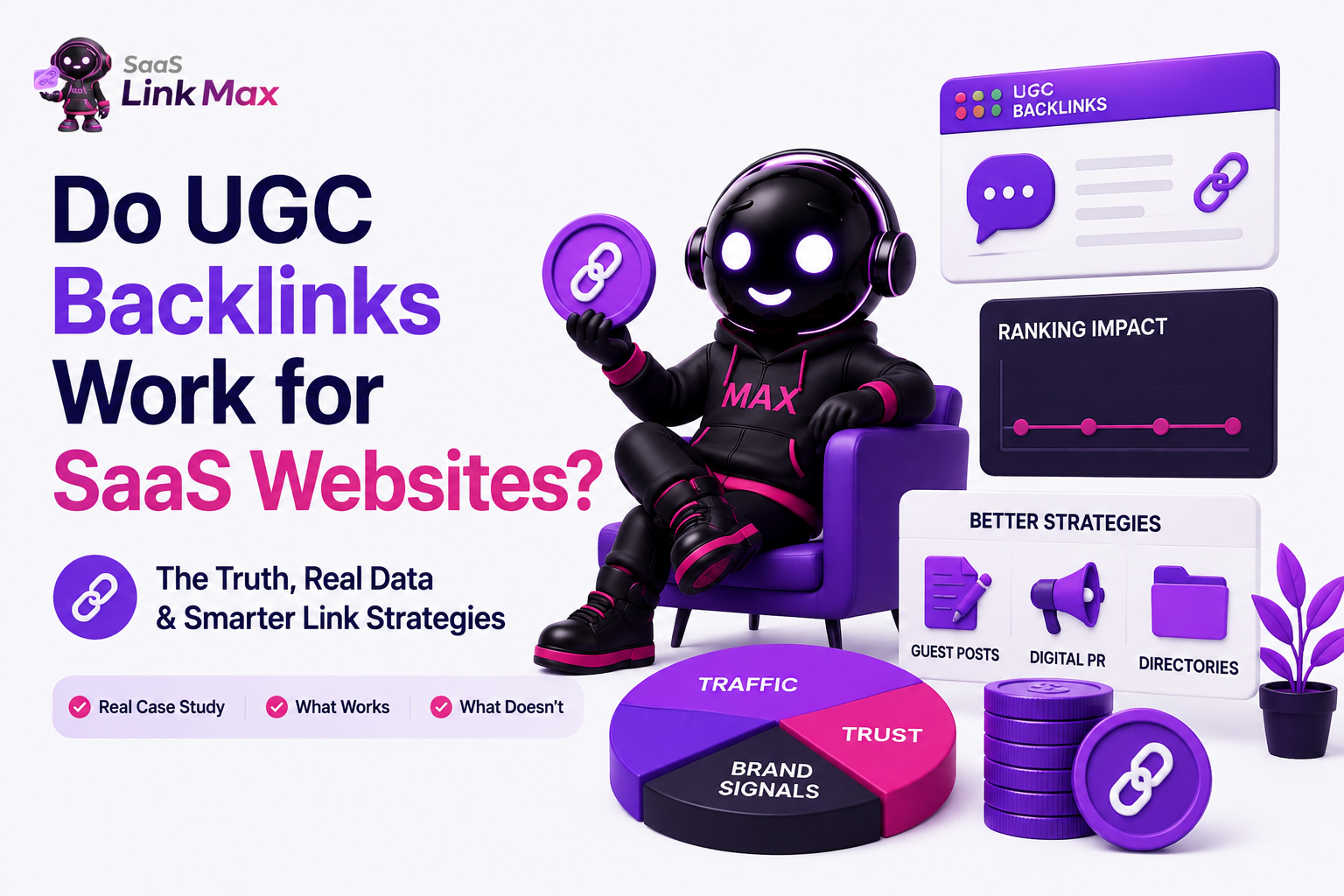
UGC backlinks almost never raise your rankings on their own, but they're genuinely useful for traffic, trust, and brand signal. The mistake most SaaS companies make is expecting UGC to do a guest post's job.
Let's break down why and how UGC backlinks can help you, using real numbers.
What Are UGC Backlinks, Exactly?
UGC backlinks are links placed inside user-generated content - forum posts, Reddit comments, Q&A answers, review site submissions, blog comments.
There's a technical wrinkle worth understanding here: the rel="ugc" attribute. This is an HTML tag that platforms like Reddit, Quora, and most forums apply automatically to user-submitted links. It explicitly tells Google that it’s not an editorially placed link.
That's different from the general term "UGC backlink," which just describes where the link lives. A lot of forums use rel="ugc" by default; some older or smaller ones don't. Either way, Google treats most links from these environments similarly, whether or not the attribute is present.
This distinction matters because it's the whole reason UGC backlinks behave the way they do in the next section.
Do UGC Backlinks Improve Rankings?
Mostly, no - and there's a clean case study that shows this clearly.
One SaaS founder hired an agency that built 1,483 UGC backlinks over 9 months, at an average site DR of 48 and average traffic of 3.7M/month, for $9.1k total. The result: no measurable movement in rankings - just normal fluctuation.
Compare that to a competitor in the same space, over the same 9-month window, on sites with the same average DR of 48: 104 backlinks, but from guest posts instead of UGC placements. That competitor saw major ranking gains and a traffic increase.
Same domain authority. Same timeframe. 14x fewer links. Dramatically better results. The variable that mattered wasn't the site's authority - it was whether the link was editorially placed or dropped into a comment thread.
This tracks with how rel="ugc" functions: it tells Google not to pass full link equity through that link, which is precisely why volume doesn't compensate. You can't out-quantity an attribute that caps the value per link.
One of our experts at SaaSLink Max shared this: "We see this exact pattern with clients constantly - they come in having spent thousands on volume-based UGC placements and can't understand why nothing moved. The math never worked in their favor to begin with. A single SaaS guest post on a relevant site will usually outperform fifty forum drops, because one is editorial and the other is explicitly discounted by Google before it even gets crawled."
So if your goal is purely "rank higher in Google," UGC backlinks for SaaS are not the tool. But that doesn't mean they're worthless, yet. They just have a different mission.
What UGC Backlinks Are Good For
Here's where the nuance lives, and where most articles on this topic stop short.
Referral Traffic
A well-placed, genuinely helpful comment on a Reddit thread or Quora answer can send real clicks to your site - people who are actively asking the exact question your product solves. This traffic doesn't care about rel="ugc"; it converts the same as any other visitor.
Brand and Trust Signals
Google's algorithms (and increasingly, AI search engines) look at more than link equity. They also use the co-occurrence of your brand name across the web - mentions, discussions, reviews - as a signal of legitimacy. This is closer to what GEO for SaaS is really about: showing up as a real, discussed entity, not just accumulating links.
Indirect Link Earning
A Reddit thread that gets real engagement sometimes gets cited by a blogger or journalist writing about the topic later. That citation is an editorial link - the kind that passes equity. The UGC placement didn't rank you directly; it created the raw material for a real backlink downstream.
Conversion Quality
Someone who finds you through a forum discussion, where real users are vouching for your product, tends to be further down the funnel than someone who clicked a banner ad.
This means that UGC is here to support other SaaS link building tactics that work for you.
The Product Hunt Playbook: UGC Done Right
If you want to see UGC backlinks working at scale, look at Product Hunt. They've built close to 100 million backlinks, and the mechanism is worth studying regardless of whether you ever list your product there.
When a product is listed on Product Hunt, the maker often embeds a small trust badge on their own site, linking back. This works the same way a Trustpilot badge works: it signals social proof, borrowed authority, and a bit of pride - "look, we're listed and doing well here." Multiply that across tens of thousands of listed products, and you get an enormous, self-perpetuating backlink engine, entirely built from user-embedded content.
Product Hunt pairs this with something smarter: dedicated /alternatives and /questions pages for every product listed. These pages target exactly the kind of buyer-intent search queries - "[Tool] alternatives," "is [Tool] worth it" - that convert well, because someone searching for an alternative to a product is already sold on the category. It's not really about backlink volume at that point; it's about occupying high-intent search real estate using content users are implicitly generating just by being listed.
This is a useful mental model for SaaS teams building their own linkable assets: if you can create something users want to embed or reference - a badge, a template, a calculator - the backlinks follow naturally, and they tend to be higher quality than anything an agency can drop into a forum.
Should You Pay an Agency for UGC Backlinks?
Be careful here. If an agency pitches you "quality UGC backlinks" from DR 80-90 sites at $6-10 a link, ask yourself the obvious question: if a link from a site that authoritative were really that easy to get, why would guest posts on the same sites cost $1,000-2,000 instead?
The honest answer is that these aren't the same product. A guest post is an editorially reviewed piece of content that the site owner chose to publish. A "UGC backlink" service is usually paying someone to drop a comment or forum post with your link in it - cheap to produce, and capped in value by design, per the rel="ugc" mechanism above.
This is one of the more common link building proposal red flags we flag for clients: volume-based pricing on placements that Google has explicitly told you it will discount. If you're evaluating a proposal and it leans heavily on UGC or forum volume without mixing in editorial placements, that's worth a second look before signing anything.
How to Use UGC for SaaS Link Building
- Answer real questions on Reddit and Quora where your product is a legitimate solution. This is closer to properly done forum backlinks.
- Build something worth embedding, like Templates, calculators, or badges that customers want to display on their own sites, and turn them into organic traffic.
- Get listed on relevant SaaS directories like G2, Capterra, and similar platforms to give you structured, credible UGC in the form of reviews.
- Try short-form product demo content. SaaS teams working with UGC creators have reported meaningful sign-up lifts from short "how I use this" clips embedded on landing pages - this is anecdotal, but consistent with what we see: authenticity converts better than polish, even if it doesn't touch rankings directly.
- Track what each channel is for. Don't judge UGC on rankings and guest posts on traffic - they're solving different problems. If you're not sure how to weigh channels against each other, our SaaS link building checklist is a useful starting point.
UGC Backlinks vs. Guest Posts vs. Directory Links
If your strategy leans entirely on one column, you're leaving something on the table. Most solid SaaS backlink profiles blend all three - often alongside SaaS niche edits and digital PR for SaaS, which tend to deliver the editorial link equity that UGC can't.
At the end of the day, building a SaaS backlink profile that helps your rankings takes a mix of editorial placements, digital PR, and the occasional well-placed UGC mention. If you want a strategy built around what works, get in touch for a free call, and let’s plan together.
FAQs
Does rel="ugc" hurt my SEO if the platform doesn't use it?
Not directly - Google can still algorithmically identify user-generated content even without the tag. The attribute is more of a courtesy signal than a strict requirement for a link to be treated as UGC.
Are nofollow or UGC-tagged links worth pursuing at all?
Yes, for traffic and brand visibility - just not for direct ranking power. Treat them as a supporting channel, not your primary strategy.
How many UGC backlinks does it take to see a brand-signal effect?
There's no fixed number. It's less about volume and more about consistency and relevance - a handful of genuinely useful, well-placed mentions in the right communities will outperform hundreds of generic ones.
Is Product Hunt's badge system considered UGC?
Functionally, yes - the badges are embedded voluntarily by users (makers), not placed editorially by Product Hunt. It's one of the better examples of UGC working at scale, largely because it's tied to genuine product listings rather than link volume.
Can UGC backlinks get you penalized?
Unless the placements are spammy, irrelevant, or clearly manipulative (e.g., mass-dropped links unrelated to the thread), this doesn’t happen.