%20(250%20x%20100%20px).png)




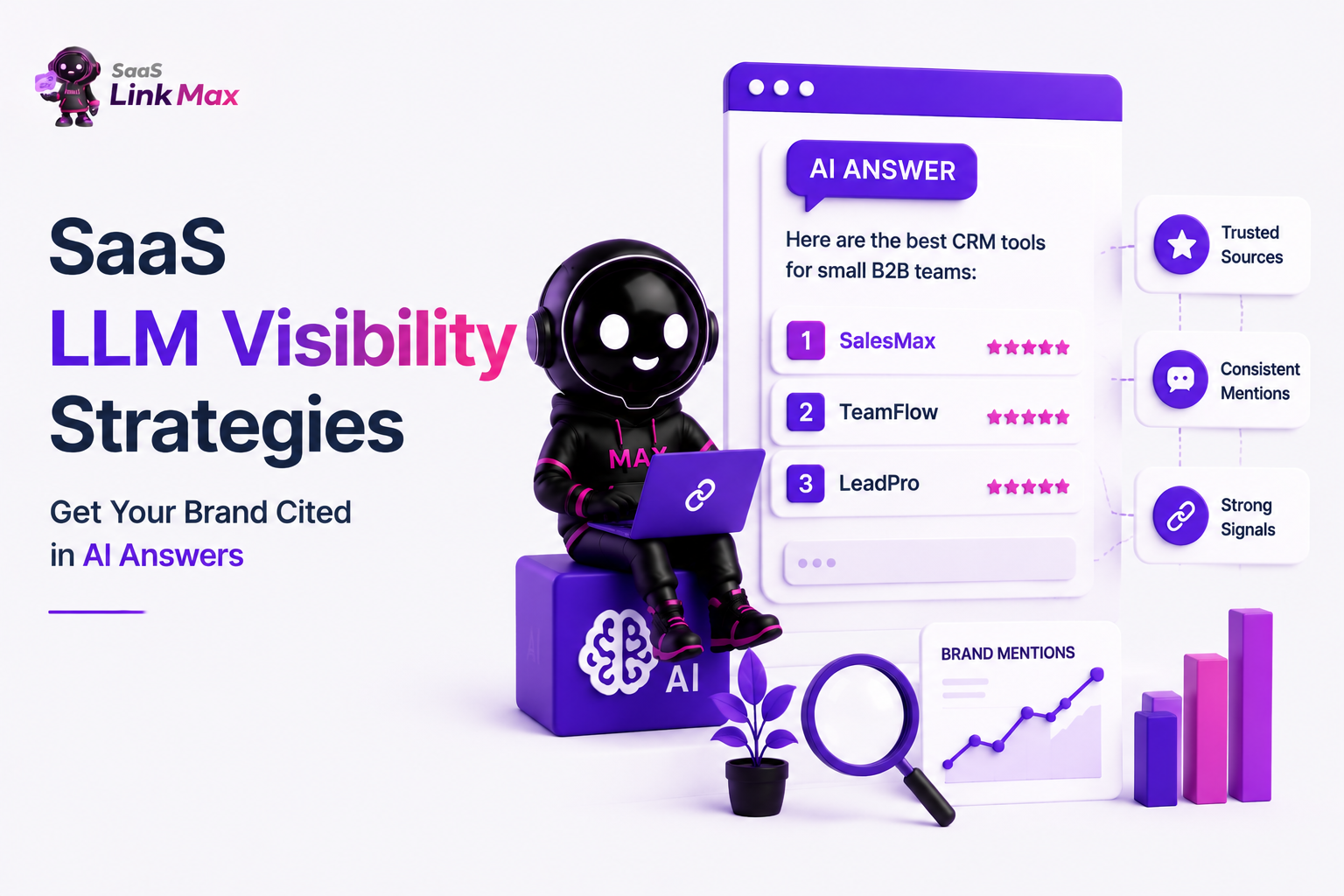
When a VP of Sales asks ChatGPT, "What's the best CRM for a 40-person B2B team?" they get a named list of three to five tools. You need to be on that list, and there are SaaS LLM visibility strategies that can help you get there.
In this guide, I will cover the signals LLMs use to select SaaS brands, and the six strategies that change your visibility. It’s based on our SaaS link building agency’s experience, so it’s SaaS-focused rather than generic LLM SEO advice. Let’s start.
How LLMs Decide Which SaaS Brands to Recommend
Before you can optimize for LLM visibility, you need to understand the selection mechanism LLMs use.
LLMs don't rank pages. They synthesize brand reputations from everything they've ever seen, cross-referenced in real time.
Training Data Density
LLMs learned from billions of documents. A brand mentioned across G2, Reddit, Capterra, integration docs, and industry blogs builds statistical association with its category. A brand that exists only on its own website has almost none of that.
Established players dominate AI recommendations due to their distributed presence. If you're a newer SaaS brand, that's where to focus. You need to start building a pattern of mentions across the web as soon as possible.
Caution: Do this without compromising quality or risking your reputation. Check out our white hat link building guide for more tips on how to do it risk-free.
RAG Retrieval at Query Time
When someone asks "best project management tool for remote engineering teams under $20 per seat," the model fires multiple sub-queries - on pricing, integrations, use-case fit, reviews - then synthesizes them into one answer.
The mechanism behind it is called RAG (Retrieval-Augmented Generation), and it works like this:
- Query: Someone asks a question.
- Retrieve: The system searches for relevant, reliable information, including the sub-queries.
- Augment: That information gets added to the original question so the model has context.
- Generate: The model reads both the question and the retrieved context, then writes the answer.
Your content needs to surface across those sub-queries.
Semantic Matching (Not Keyword Matching)
Unlike search engines that look for the words when someone types a question, the AI models search for meaning. They figure out what the person is really asking for, then look for brands that match that meaning.
If your positioning is vague ("we help teams collaborate better"), there's not much meaning to match against. The model has no clear signal for when to surface you.
If your positioning is specific ("project management for distributed engineering teams, integrates natively with GitHub and Jira, $12 per seat"), the model knows exactly what you do, who you serve, and when you're relevant, and recommends you accordingly.
The more precisely you describe your product, the more reliably AI recommends it.
Cross-Source Consensus
If your G2 profile, three industry blogs, and your own website all describe your product consistently, using the same use cases, same integrations, same value prop - the model reads that as a trust signal and cites you.
If they give different signals, the model can't verify the claim and often skips you. Inconsistent messaging actively suppresses your citation rate.
The 6 SaaS LLM Visibility Strategies For 2026 (Tested)
Now you know how LLMs work and what you should always pay attention to, specifically if you are a SaaS company. So, let’s go a bit deeper and understand the exact strategies that could help you increase brand awareness.
1. Build the Content Types that Get Cited in Software Queries
In LLMs’ eyes, not all content is equal, and more importantly, citable. Three formats dominate the citations we see in software category queries:
- "Best X for Y" listicles
- Comparison pages
- Use-case landing pages
We actively use all three when working with our clients, so let me give you a bit more insight into each.
"Best X for Y" Listicles
LLMs are trained on these and actively retrieve them when answering buyer questions.
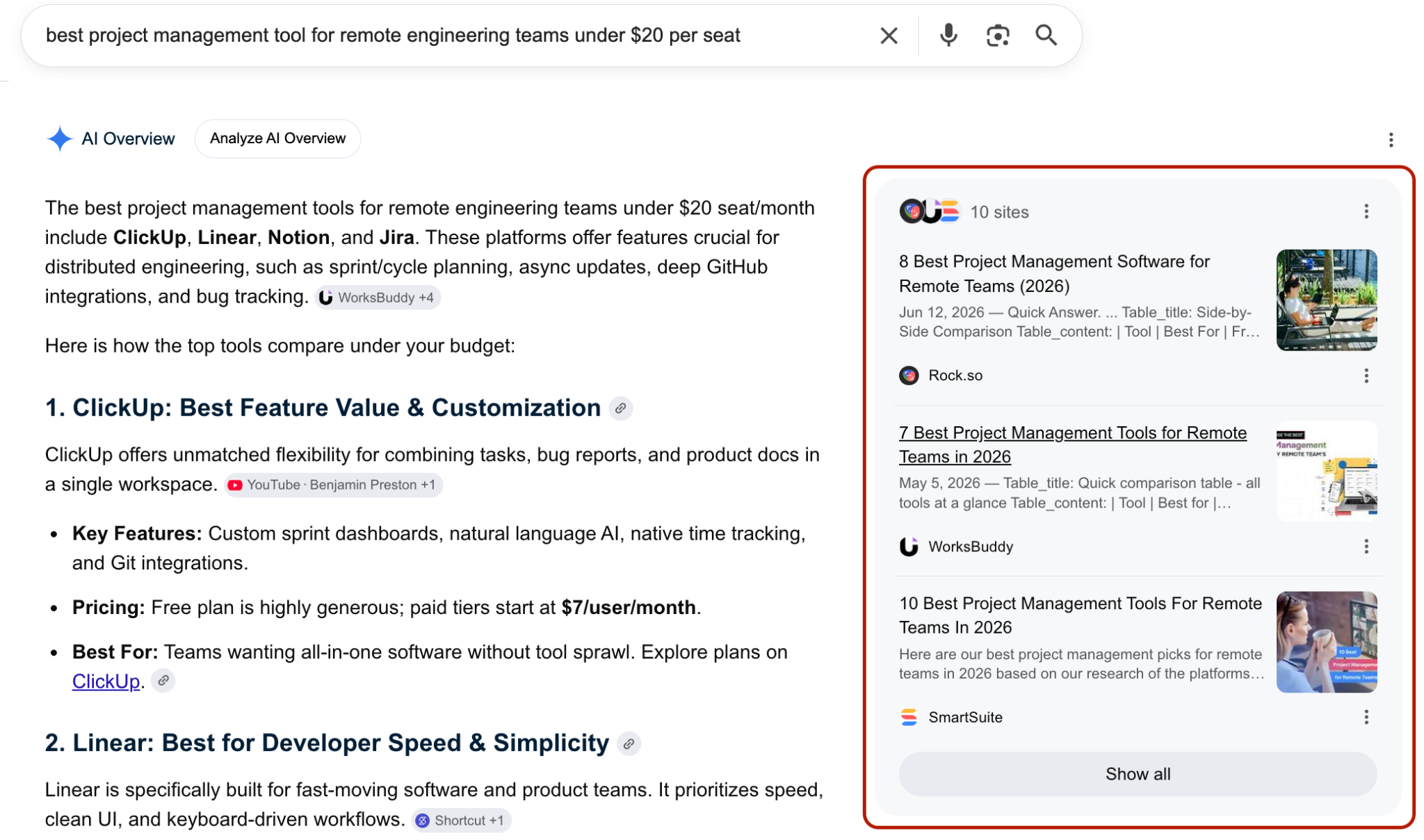
Listicles and roundups need to be structured properly: tight, numbered lists; individual product sections with clear feature callouts; and explicit verdict sentences.
A tactical note we've validated with our own clients: any category listicle you publish and feature your own product should have the same specificity you'd give competitors. Don’t be promotional; rather, factual with genuine feature and use-case detail. If your product section is thinner than the competitor sections, the LLM learns less about you from that page.
Comparison Pages
"Tool A vs Tool B" pages are among the highest-intent content a SaaS company can publish, and they're what buyers are literally typing into AI tools. "HubSpot vs Salesforce for early-stage SaaS" is an exact buyer prompt.
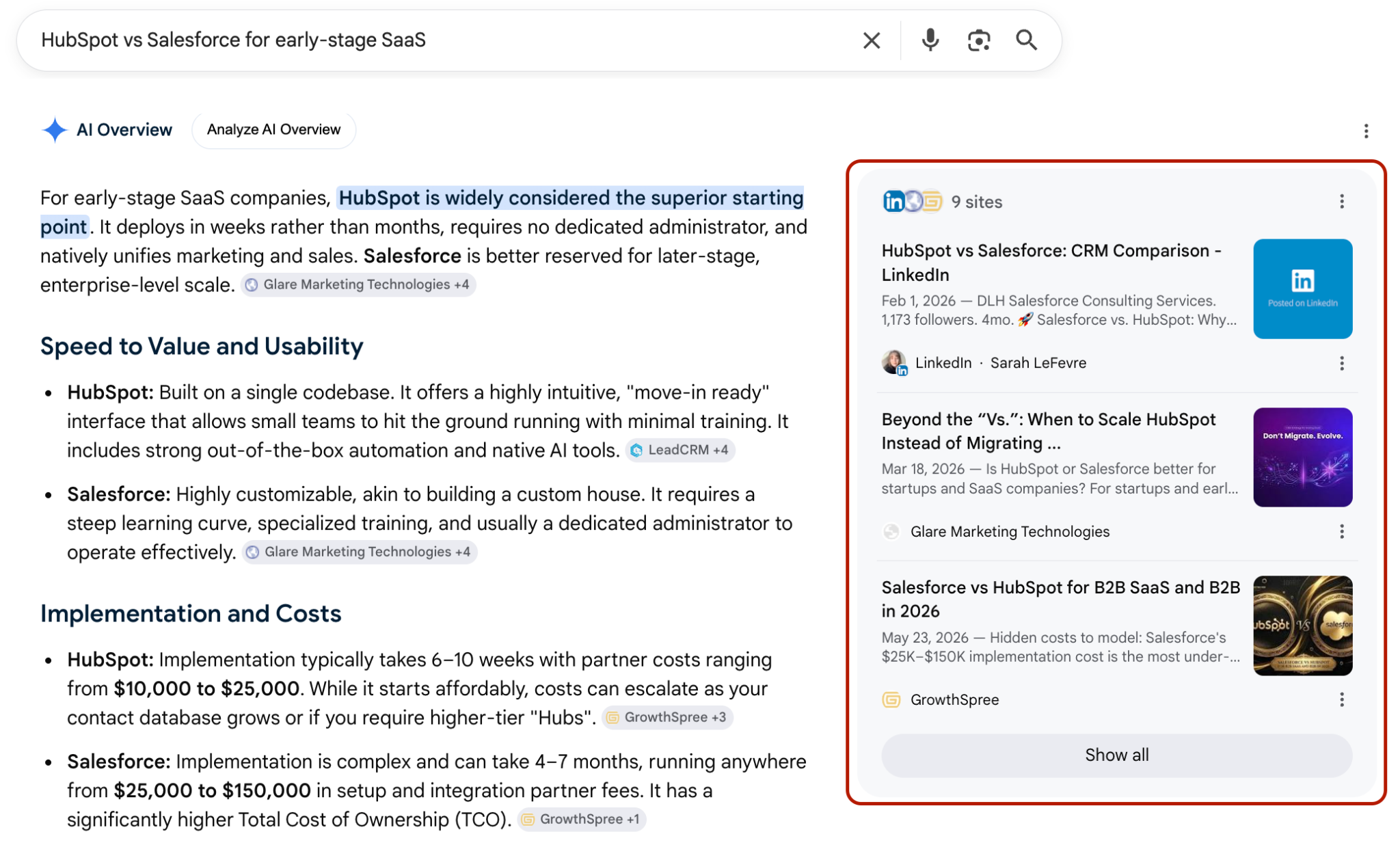
These pages need to answer it with explicit pricing differences, integration gaps, and use-case fit. It should never be hedged diplomatic prose that refuses to choose a winner.
Use-Case Landing Pages
"Project management for remote engineering teams" converts far better than a generic features page, and gets cited far more often. The closer your page matches the specifics of a real buyer prompt, the higher the probability of citation.
This is also where we see a strong SEO crossover benefit: long-tail, use-case-specific pages tend to rank in traditional search and get retrieved by LLMs for the corresponding prompts. Two birds, one piece of content.
2. Own Your Off-Site Presence
This is the most counterintuitive and most important fact about SaaS LLM visibility: about 85% of LLM citations for broad-category queries come from third-party sources.
This changes where you should invest your time. It’s the right kind of link building, like manual link building, or digital PR. But now, let’s focus on the three most overlooked yet important SaaS LLM visibility strategies in this category.
Use Review Platforms as Citation Infrastructure
G2, Capterra, Trustpilot, and niche directories are the primary citation layer LLMs draw from when answering software questions.
When developing your citations for them, make sure to do these specific moves:
- Drive verified reviews that use specific use-case language (not generic "great tool" praise)
- Keep your profile descriptions updated with the same precise positioning language on your website
- Respond to reviews so the content around your listing is richer
Get Into Already-Ranking Listicles
You saw that LLMs mainly pull from listicles, but the brands mentioned aren’t necessarily the ones writing them. They are simply mentioned the most and the most consistently.
So, to make things simpler, find the listicles that already rank on page one for your category keywords, and get listed there. You can do a link exchange (ethically and carefully), but it’s better to do a more professional listicle link building for SaaS.
For example, in the case of an influencer marketing platform, a big part of our link building work was to place them in category roundups and "best influencer marketing tools" lists across mid-authority and high-authority publications.
In the end, beyond the direct SEO value, those placements created exactly the distributed brand signal that LLMs look for: multiple independent sources naming the same tool in the same category context.
Community and Forum Presence
Reddit threads, Quora answers, and niche community discussions are heavily indexed by LLMs, especially for conversational queries. When our team audits LLM citation sources for clients, forum content regularly appears. Forum backlinks and genuine community participation feed the semantic data pools that shape AI recommendations.
The keyword is genuine: participating with useful, specific answers in relevant subreddits outperforms any manufactured brand mention. If this rule is not followed and detected by the platform, you will be removed from most forums for violations.
3. Structure Your Own Content for Extraction
LLMs parse HTML and pull structured chunks. Think for yourself: in most cases, it’s too expensive for LLMs to generate their own results, so if your section/paragraph is a fitting answer to the query it got, it will just pull your text to save resources.
But if your content isn't structured for clean extraction, the model either pulls a confused partial chunk or skips you in favor of a competitor whose content is easier to process.
To structure your content better for any of the SaaS LLM visibility strategies, follow these simplified guidelines created by our content lead:
One Idea Per Block
If a paragraph contains three related ideas, the LLM either misrepresents all three or drops the less prominent ones. Break complex thoughts into separate, self-contained paragraphs. Each block should stand alone if lifted from its context.
Question-Answer Scaffolding
Lead every section with a direct, declarative answer (one or two sentences that answer the implied question), then expand with evidence and context. The short version gets surfaced in AI responses. The depth signals expertise to human readers.
This format is what we build into every content brief when we're optimizing SaaS websites for GEO and AI visibility alongside traditional SEO.
Declarative Judgment Sentences
"For Series A SaaS teams managing outbound sales, [Tool X] outperforms spreadsheets because..." These are the exact sentences LLMs echo back when recommending software. Vague comparative language ("can be a good option depending on your needs") gets ignored. Write like you have an opinion, because you're supposed to.
Keep Paragraphs Under 300 Tokens
This sounds technical, but the practical version is simple: shorter paragraphs get retrieved and cited more reliably than dense blocks of text. Aim for four to six sentences per paragraph maximum.
Use Tables for Comparisons
When comparing pricing tiers, feature sets, or integration options, a table is easier to extract than prose. LLMs can parse tabular data cleanly and surface it directly in answers.
4. Lock in Brand Entity Consistency Across Every Surface
LLMs are pattern-matching machines. When they encounter your brand, they're building an internal representation of what you do, who you do it for, and whether you're trustworthy. Every inconsistency weakens that representation.
Create a brand dictionary and apply it to every public surface: your website, G2 and Capterra profiles, help center, press releases, partner listings, and any third-party content you contribute to.
The dictionary should cover:
- Exact product names and tier names
- Approved value propositions phrased identically
- Integration names written consistently
- Performance claims with supporting evidence
- ICP descriptors (who the product is for, stated in the same terms everywhere)
We've seen this catch clients off guard. Their homepage describes the product as "AI-powered inventory management," their G2 profile calls it "inventory tracking software," and their Capterra listing says "warehouse management platform." Three different category associations, none of them strong. The LLM builds a weak, diffuse picture and defaults to recommending a competitor with cleaner positioning.
5. Run Digital PR and Original Research
Mentions from authoritative publications and original data are among the strongest LLM citation signals. Brand mentions across multiple credible sources correlate with AI Overview placement at roughly 3:1 over traditional backlinks alone.
The content types that generate these mentions:
Original Data Studies
Survey your users, analyze anonymized product data, or commission research on your category. Publish the findings with clear, citable statistics. LLMs can't invent data. Although some hallucinations still happen, when they encounter a specific, well-attributed statistic, they retrieve the source. Original data is one of the few content types and linkable assets that earns citations semi-permanently.
Expert Case Studies with Specific ROI Numbers
"Client reduced sales cycle by 23% using [Feature]" is citable. The specificity is what makes it extractable.
Strategic PR Placements in Trade Publications
A placement in a SaaS-focused newsletter or industry publication that your buyers read does more for LLM visibility than a generic tech press mention, because the LLM is more likely to retrieve category-relevant sources when answering category-specific questions. That’s digital PR for SaaS at its finest.
Podcast and Webinar Transcripts
If the transcript is publicly indexed, it becomes a retrievable document. Getting on a relevant podcast is good for brand awareness in general, and it also creates indexed content that LLMs can draw on.
6. Keep Your Authoritative Content Fresh
65% of AI bot crawl activity targets content published within the past year. Pages updated within two months earn roughly 28% more citations than equivalent pages that haven't been touched.
The practical implication of this is your highest-priority pages need a quarterly review cycle. That’s not a full rewrite. Updating data, refreshing examples, adding a new case study reference, and ensuring the last-modified metadata is up to date is often enough. But it has to happen.
For SaaS companies specifically, the pages that matter most are:
- Pricing pages (LLMs frequently cite these for budget-specific queries),
- Comparison pages (updated competitive intel matters),
- Use-case landing pages (new customer examples and feature additions).
If these pages were written eighteen months ago and haven't been touched, you're competing against fresher content from competitors who are paying attention to this.
Freshness also matters because your product changes over time. If a competitor released a feature you've now matched, but your comparison page still shows you losing on that dimension, LLMs will cite the outdated comparison and send buyers to your competitor.
What SaaS LLM Visibility is Not
Two misconceptions worth clearing up directly, because they lead to wasted effort.
SaaS LLM visibility is not the same as ranking #1 in Google. Only 12% of URLs cited by ChatGPT and Perplexity rank in Google's top 10. Traditional keyword rankings are a weak predictor of LLM citation, and in some categories, the correlation is near zero. Brands with modest domain authority and strong distributed presence often outperform high-DA competitors in AI recommendations. The signals are genuinely different.
SaaS LLM visibility is not primarily about your own content. Given that ~85% of citations come from third-party sources, treating LLM visibility as a publishing problem will get you about 15% of the way there. It's a brand distribution problem.
This is also why SaaS link building strategies and LLM optimization are more closely connected than most people realize. The same off-site presence that earns SEO authority also brining in LLM citations.
How to Track Your SaaS LLM Visibility
You can build a manageable tracking foundation with a couple of link building tools:
Start with a manual baseline. Write 15-20 prompts that a real buyer in your ICP would type into an AI tool. Think: "best [your category] for [your ICP], " "[your category] tools under $X per month," and "[competitor] alternatives." Run these across ChatGPT (with web search enabled), Claude, Perplexity, and Gemini. Log three things for each: is your brand named, what position is it in, and what sources does the LLM cite alongside your brand?
Run the exact same prompts for your top three competitors. That's your share-of-voice baseline. It costs nothing and takes about two hours.
Four metrics that matter for SaaS specifically:
- Mention rate - how often your brand appears across your target prompts. Test 20 prompts; appear in 4. Your mention rate is 20%. This is your headline number.
- Mention position - first in a list of five is not the same as fifth. Buyers weight order. Track where you appear, not just whether you appear.
- Citation source - which third-party pages the model cites alongside your brand. This is the most actionable metric: it shows exactly where your off-site presence is working and where it's thin. If Perplexity cites a G2 page for your competitor but never yours, you have a specific gap to fix.
- Sentiment framing - how the model describes you. "Great for mid-market teams but pricing can be steep for smaller companies" is a perception problem you can fix with content.
For scale and ongoing monitoring of how well your SaaS LLM visibility strategies work, platforms like Semrush AI Toolkit, Search Atlas, and Peec AI now offer dashboard-level LLM visibility tracking. They're worth evaluating once you have a manual baseline established and know what you're looking for.
The SaaS LLM Visibility Audit - Start Here
Run through these five questions. Your answers define your priorities.
1. What does ChatGPT say when asked: "best [your category] for [your ICP]"? Run the query with web search enabled. Is your brand named? In what position? What sources does the model cite? If you're absent, that's your baseline. If you're present but cited last, that's a different problem.
2. Does your G2/Capterra profile use the same positioning language as your website? Pull both open side by side. If you'd describe your product differently to someone reading each one, the inconsistency is costing you citation probability.
3. Which ranked listicles in your category feature your product? Search for "best [your category] software," "top [your category] tools for [ICP]," and "[your category] alternatives." Open the top five results for each. Count how many feature you. Those you're missing from are your outreach list.
4. Do you have comparison pages for your top three competitors? If not, you're invisible for the queries "[Competitor] vs [your brand]" and "[Competitor] alternatives" — two of the highest-intent prompts buyers type into AI tools.
5. When did you last update your highest-priority pages? Pricing, comparison, and use-case pages. If the answer is more than three months ago, put a content refresh on the calendar before anything else.
If you want to talk through how this applies to your specific category and ICP, we work exclusively with SaaS companies at exactly this intersection of link building, digital PR, and LLM visibility strategy. Just contact us and let’s have a free online talk about what SaaS LLM visibility strategies you need.
FAQ
What is SaaS LLM visibility?
SaaS LLM visibility refers to how often and how accurately large language models like ChatGPT, Claude, and Perplexity name and recommend your software brand when buyers ask AI tools about solutions in your category. High visibility means appearing consistently on AI-generated shortlists. Low visibility means you're absent from the moment buyers form their opinions.
Why do only 12% of SaaS brands appear in AI recommendations?
Most SaaS brands focus their presence exclusively on their own website, while approximately 85% of LLM citations come from third-party sources - review platforms, category listicles, trade publications, and community discussions. Brands with strong distributed presence across these sources are far more likely to be cited.
How is LLM visibility different from SEO?
Traditional SEO optimizes for ranking on Google's results pages. LLM visibility optimizes for being named inside AI-generated answers. The overlap is real (authoritative content and quality backlinks matter for both), but the signals aren't identical.
How long does it take to improve LLM visibility for a SaaS company?
Brands with existing third-party presence (reviews, listicle mentions, PR coverage) typically see measurable shifts in 8–12 weeks after tightening their brand language and off-site content. Brands starting from limited presence should expect 3–6 months before citation patterns become consistent.
What content types get cited most often in AI software recommendations?
Category listicles ("best X for Y"), direct comparison pages ("Tool A vs Tool B"), use-case landing pages, and third-party review platform profiles are the most frequently cited content types for software queries. Original data studies and expert case studies with specific metrics also reliably earn citations.
How do I track my brand's LLM visibility?
Start manually: write 15-20 prompts that real buyers would use, run them through ChatGPT, Perplexity, Claude, and Gemini, and log whether your brand appears, in what position, and which sources are cited. Run the same for your top three competitors.