%20(250%20x%20100%20px).png)




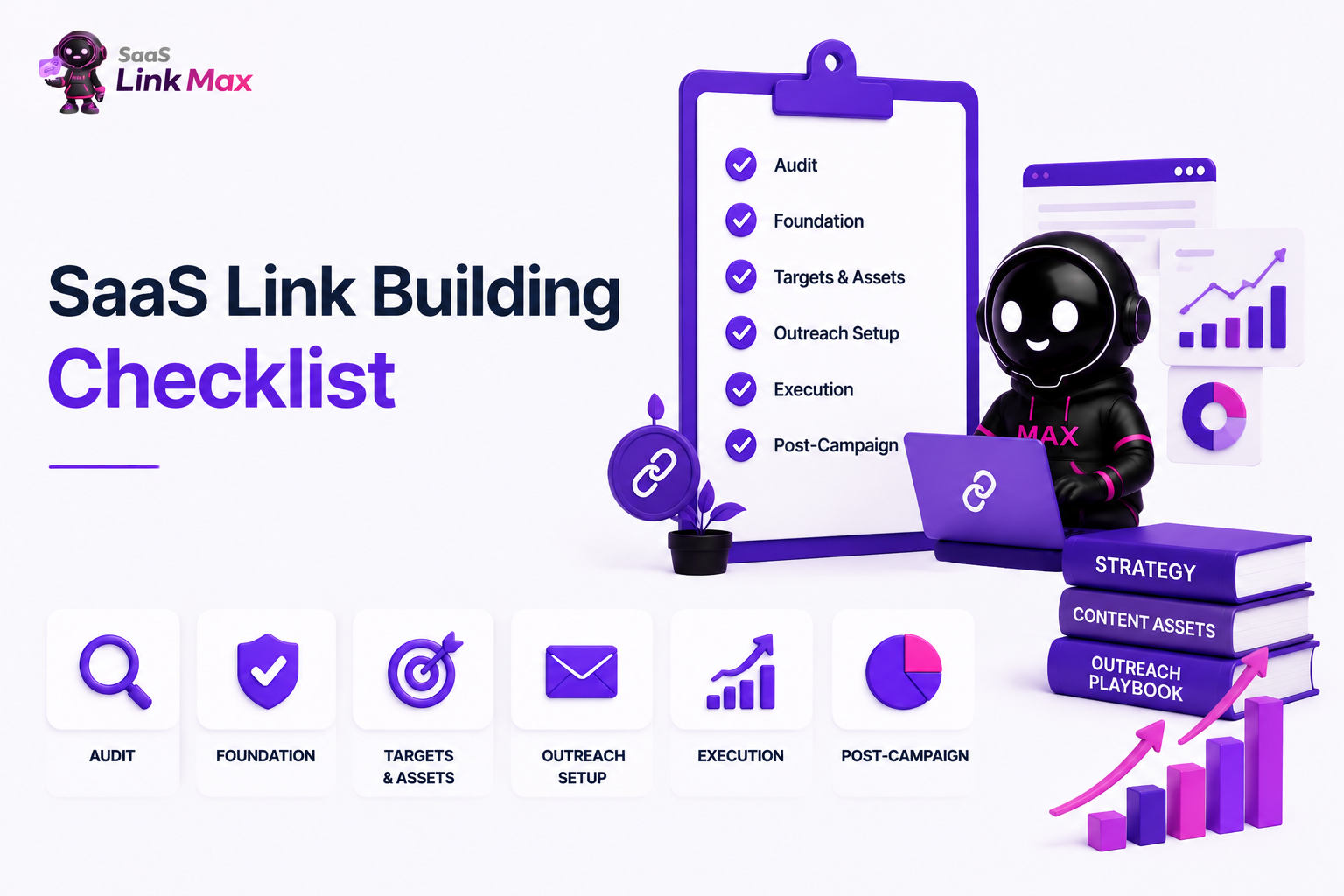
This SaaS link building checklist is a working reference - the exact phase-by-phase checklist we use at our SaaS link building agency when we kick off a new campaign.
Work through it in order, and you'll have a clear campaign foundation before you send a single outreach email.
If you want the reasoning behind each tactic, when to use which link type, how to choose between guest posts and niche edits, that's covered in our SaaS link building strategies guide. This checklist assumes you've got your strategy sorted and need the operational rundown.
Phase 1: Audit
You can't build a SaaS link building campaign without knowing your baseline. If you skip this phase, consider you're spending budget on the wrong pages, target the wrong competitors, and build teh wrong links.
Backlink Profile
- Pull your full referring domain count in Ahrefs, Semrush, or Monitolink
- Check your Domain Rating (DR) or Domain Authority (DA)
- Review your link velocity over the past 12 months (new vs. lost domains)
- Check anchor text distribution - flag anything with exact-match anchors above 5%, which is a warning sign for over-optimization
- Identify your most-linked pages (sort by referring domains in Ahrefs Top Pages)
- Flag any toxic or spammy links that need disavowing (unrelated foreign-language sites, PBN patterns, sudden spike-and-drop domains)
Competitor Gap Analysis
- Identify your top 3 competitors for your primary target keywords
- Pull each competitor's backlink profile and export to a spreadsheet
- Run a link intersect (Ahrefs Competitive Analysis > Referring Domains > All Competitors) to find sites linking to multiple competitors but not to you - these are your highest-probability targets
- Note the average DR of competitor backlinks and what link types dominate (guest posts, directories, digital PR, niche edits)
Page-Level Link Gap
- For each priority page, check how many referring domains the top-ranking competitor has vs. yours - this number becomes your campaign target
- If you're consistently 20+ referring domains behind on key pages, understand how many backlinks you need before setting expectations
Internal Link Audit
- Run your site through Screaming Frog or Ahrefs Site Audit
- Flag orphan pages (no internal links pointing to them)
- Flag pages more than 3 clicks from your homepage
- Confirm your most-linked content passes authority to your key commercial pages via internal links - if not, add them before running outreach
Phase 2: Foundation - Building Entity Signals First
Before you build editorial links, make sure your entity signals are solid. Google uses these to verify that you're a real, legitimate business. They're also quick wins that take an afternoon to set up and never need revisiting.
- Google Business Profile claimed and accurate
- Bing Places listing created
- LinkedIn company page live with consistent brand name, description, and URL
- Crunchbase profile created (especially important for B2B SaaS)
- G2, Capterra, or TrustRadius listing live - whichever is most relevant to your category. These rank for high-intent "best [category] software" keywords independently of your site
- Industry-specific directories and association listings confirmed
- Integration partner pages - check that tools you integrate with (Zapier, HubSpot, Salesforce, etc.) link back to your site. Integration directories are underrated sources of clean, relevant backlinks
- Existing customer, partner, or investor sites - ask whether a mention or link fits naturally
Phase 3: Targets - Choosing the Right Pages and Assets
One of the most common mistakes we see: SaaS companies building all their links to the homepage. That can work for brand signals, but it does very little for the feature pages and commercial landing pages that convert. So, in this phase of our SaaS link building checklist, let’s address it.
Target Page Selection
- Select 2-4 priority pages for this campaign cycle - ideally feature pages, comparison pages, or high-intent blog content sitting between positions 8-20 for a target keyword
- Confirm each page is fully indexed, has solid on-page SEO, and has a clear conversion path - don't build links to thin or incomplete pages
- Assign a referring domain target to each page based on your competitor gap analysis
Linkable Asset Identification
- Audit your existing content for linkable assets - original research, free tools, comprehensive guides, data-driven statistics pages. These earn links passively and dramatically improve outreach conversion rates when you have something genuinely worth pitching
- If you don't have linkable assets yet, identify one you could build this quarter. A single well-executed original study can earn more links than six months of guest post outreach
- Check which of your competitor's pages have the most referring domains (their linkable assets) - these show you what the market is willing to link to
Listicle and Roundup Gap
- Search for "best [your category] software," "top [your category] tools," and "[competitor] alternatives" in Google
- List every ranking listicle or roundup that includes competitors but not you - these are priority outreach targets. Getting featured in a well-ranking listicle puts you in front of buyers actively researching software and, increasingly, in front of AI systems pulling SaaS recommendations from exactly these pages
- Note which listicles are already linking to multiple competitors - those editors are clearly open to featuring tools in your category
Unlinked Brand Mentions
- Set up Google Alerts for your brand name and key product names
- Run your brand name through Ahrefs Content Explorer (In Content > Highlight Unlinked) to find existing mentions without links
- Log every unlinked mention - these are your easiest link conversions because the author already knows and likes your product
Phase 4: Outreach Infrastructure - Set This Up Before You Contact Anyone
This is the phase most teams skip, and it's why so many outreach campaigns land in spam folders or get accounts suspended. Set it up once; it scales indefinitely.
Email Deliverability
- SPF record added to your sending domain's DNS - tells email providers which servers are authorized to send on your behalf
- DKIM record added - adds an encrypted signature proving emails weren't tampered with in transit
- DMARC record added - sets policy for what happens when messages fail SPF or DKIM checks
- Verify all three records are live using a tool like MXToolbox before sending anything
- If using a dedicated sending domain (e.g., outreach.yourdomain.com), confirm it's warmed - a brand-new inbox sending 100 emails on day one will be flagged immediately. Ramp from 10/day in week one to 50–100/day by week four
Tools and Tracking
- Outreach platform configured (Pitchbox, Instantly, or equivalent) - you need automated follow-up, personalization variables, and reply tracking
- Prospect tracker built in Google Sheets or your tool of choice. Minimum columns: Prospect URL, DR, Contact Name, Contact Email, Outreach Date, Reply Status, Live Link URL, Dofollow Confirmed, Date Indexed
- If you haven't already, choose your link building tools and make sure they're connected and pulling data correctly
Email Templates
- Write at least 3 outreach template variations for each link type (guest post pitch, niche edit request, unlinked mention follow-up, broken link pitch)
- Every template should be under 100 words, reference something specific about the target site, and make the ask clear. No "I was having my morning coffee when I found your site" openers
- Subject lines should be tested - try 2-3 variations per template to find what drives opens in your niche
Phase 5: Prospect Evaluation - Before You Pitch Anyone
Run every prospect through this filter before it enters your outreach queue. The goal is to avoid wasting budget on placements that contribute nothing - or worse, links from sites Google is likely to algorithmically discount.
For each prospect, confirm:
- Topical relevance first - does this site publish content that your target audience reads? A DR 40 SaaS-focused blog beats a DR 70 lifestyle site every time. Topical relevance is the primary filter; everything else is secondary
- DR 30+ minimum - anything below this typically has too little authority to move rankings, though exceptions exist for hyper-relevant niche sites
- Organic traffic is real and stable - pull the domain into Ahrefs or Semrush. Look for consistent, gradual growth. Sudden spikes followed by drops are a penalty signal. A high DR with near-zero organic traffic means the domain has artificially inflated metrics — skip it
- No PBN signals - check the referring domains report. Red flags: bulk links from unrelated foreign-language sites, obvious link farm patterns, no identifiable real authors, no social presence, content that reads as purely SEO-generated
- Site is actively maintained - new content published within the last 90 days, real author profiles, working contact information
- Target page is indexable - paste the URL into Google with a site: prefix. If it doesn't appear, the page has no indexing value regardless of domain authority
- Link placement is in-body - confirm you're getting a contextual link inside the article content, not a footer link, sidebar widget, or author bio. In-body, early-placement links carry significantly more weight. Contextual backlinks are what you're after
If a site passes all seven, it enters your outreach queue. If you're uncertain, check our link building proposal red flags to see what legitimate agencies look for vs. what to avoid.
Phase 6: Link Type Selection - Match the Tactic to the Goal
You don’t need the same link types for all your campaigns. So, use this matrix to understand which one you need, and consider it a step in your SaaS link building checklist:
Before confirming your link mix, check your anchor text plan against your vetting data. Most strong SaaS backlink profiles are heavily branded (company name, product name, naked URL), with keyword-rich anchors used sparingly. If your profile already has a high ratio of exact-match anchors, add more branded and natural anchors first.
Phase 7: Live Link Quality Control - Verify Every Placement
A confirmed placement is not a win. A confirmed, indexed, dofollow, correctly-anchored link is a win. Check every link before logging it as complete.
- Dofollow confirmed - view the page source or use the Ahrefs SEO Toolbar. Check for rel="nofollow", rel="sponsored", or rel="ugc" attributes. If you find one and it wasn't agreed, contact the editor and request correction
- Anchor text matches agreed terms - check the actual live anchor, not the draft. Editors sometimes change anchor text during publishing
- Target URL is correct - verify the link points to the exact page you specified, not the homepage or a different URL
- Link is indexed - run site:[linked page URL] in Google. If the page doesn't appear, the link is not being counted. Flag it in your tracker and follow up if it's still unindexed after 30 days
- Link is in-body - confirm it's inside the article content, not relegated to a related links widget or footer during editing
- Log everything - record the live URL, anchor text, DR, link attribute, and date confirmed in your tracker. This is the data that proves campaign progress
Phase 8: Ongoing Maintenance - Run This Monthly
Link building is not a one-time exercise. Links decay: pages get deleted, sites get redesigned, editors clean up old posts. A campaign without monitoring is a campaign silently losing ground.
Run this monthly:
- Lost link report - pull lost links from Ahrefs or Semrush. For any link above DR 40 lost in the past 30 days, investigate the cause (page deleted, site redesign, link removed) and attempt recovery by contacting the site owner
- Referring domain count vs. last month - are you net positive? A flat or declining count means new links aren't outpacing losses
- Target page rankings checked - are the pages you built links to moving? Track positions in Ahrefs Rank Tracker or Google Search Console and map movement to link activity
- New unlinked mentions found - check Google Alerts and Ahrefs Content Explorer for fresh brand mentions. Reach out within 2-3 weeks while the article is still fresh
- Competitor new links reviewed - pull competitor new backlinks monthly. If a site just linked to two of your competitors and not you, it's a warm prospect worth prioritizing
- AI visibility check - if your SaaS is showing up in Google's AI Overviews or being recommended by ChatGPT and Perplexity, track it. GEO for SaaS is increasingly linked to the same listicle and editorial placements that drive traditional SEO - the campaigns compound across both
What Makes a SaaS Backlink Good
Before you use this checklist on any new campaign, make sure you and your team are aligned on what "good" means. Here's the short version:
Topical relevance over DR. A DR 35 blog read by SaaS founders in your category is more valuable than a DR 70 general marketing site. The link needs to make sense to a human reader, not just pass a domain authority filter.
Traffic is non-negotiable. High DR with no organic traffic is a red flag, not an asset. Always verify in Ahrefs or Semrush before pitching.
In-body placement, not footer. A link buried in a sidebar or footer passes almost nothing. Early, contextual, in-article links are what you're after.
Natural anchor text. Most of your anchors should be branded or neutral (your company name, your product name, your URL). Keyword-rich anchors help but become a liability when overdone. Model your anchor mix on the top-ranking competitors for your target keywords — don't guess.
Dofollow only counts as a backlink. Nofollow links can still drive referral traffic and brand mentions, but they shouldn't be counted in your referring domain target for ranking purposes.
For a deeper look at what separates strong backlinks from weak ones, see our breakdown of white hat link building.
Using This SaaS Link Building Checklist as a Repeating Workflow
Work through each phase of the SaaS link building checklist sequentially on your first campaign. After that, Phases 1 and 2 become quarterly reviews, Phases 3-7 run for each campaign cycle, and Phase 8 runs every month regardless.
If you'd rather have someone run this process for you,we works exclusively with B2B SaaS companies. See how we work or get in touch if you want a campaign audit or a custom SaaS link building campaigns for your needs.
Frequently Asked Questions
How long does it take for backlinks to affect rankings?
Typically 6-12 weeks from when a link goes live and gets indexed. How long backlinks take to have an effect depends on your site's crawl frequency, the linking domain's authority, and the keyword's competitiveness. Don't expect overnight movement.
How many backlinks do I need to rank?
It depends entirely on the SERP. Pull the top 3 competitors for your target keyword, check their referring domain count on that specific page, and use the gap as your campaign target.
Should I buy backlinks?
It's nuanced. Paying for guest post placements on legitimate sites is standard practice. Buying bulk links from link farms or directories with no real audience is a different thing entirely. Whether you should buy backlinks in 2026 comes down to what you're buying, from whom, and whether the placement passes a genuine quality vetting process.
How much do SaaS backlinks cost?
It varies widely by domain authority, traffic, and placement type. We broke down how much SaaS backlinks cost across different link types and DR ranges if you're trying to budget a campaign. Identify this before you go through the SaaS link building checklist so you don't go against your budget.