%20(250%20x%20100%20px).png)




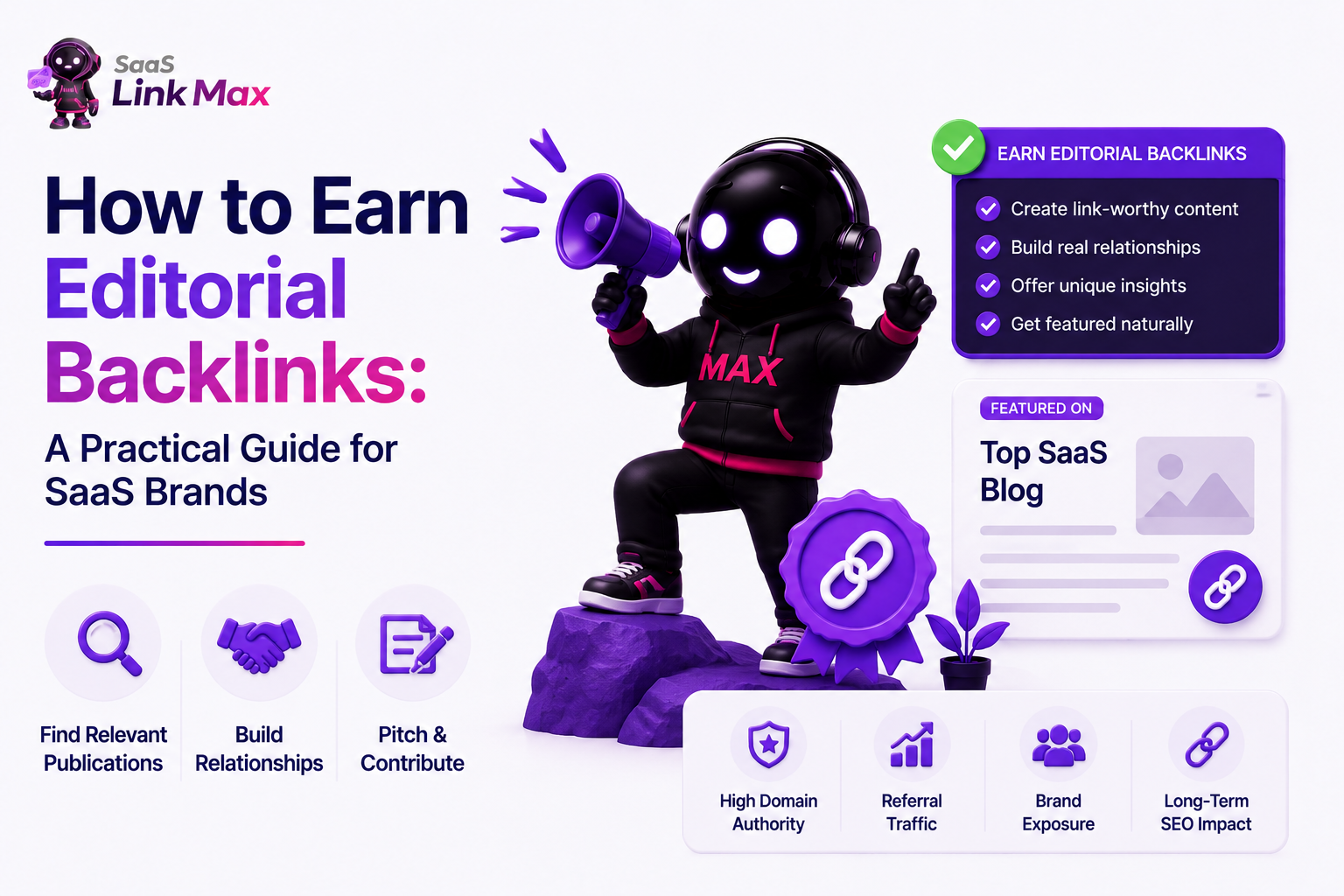
Most SaaS teams already know they need backlinks. What trips people up is the "editorial" part - the difference between a link that helps rankings and a link that just sits in a directory doing nothing. This guide skips the theory and gets straight into what an editorial backlink is, why SaaS brands specifically struggle to earn them, and the exact methods that work in 2026.
We run a SaaS link building agency for a living, so everything below is pulled from what gets a "yes" from an editor.
What Is an Editorial Backlink?
An editorial backlink is a link an editor or writer places inside their content because your resource genuinely helps their piece - not because you paid for it, swapped it, or submitted it to a directory. It's earned, not placed.
Here's the quick way to tell the difference:
If you want a deeper breakdown of what counts as a genuine editorial or contextual backlink versus a link that Google is likely to discount, it's worth understanding before you spend a single hour on outreach - otherwise you'll chase the wrong links entirely.
Why SaaS Brands Have It Harder (and Why It's Worth It)
Your SaaS money pages - pricing, product, features - are exactly the pages nobody wants to link to. A journalist writing about project management trends isn't going to cite your pricing page. They'll cite a data study, a free tool, or a genuinely useful guide.
That means the SaaS playbook always runs in two steps: build an asset worth citing, earn the link to that asset, then pass the authority internally to the pages you want to rank. Skip step one, and no amount of outreach will save you - manual link building without an asset behind it is just cold email with nothing to offer.
It's also a genuinely competitive game. SaaS keywords are national or global, not local, so you're up against well-funded incumbents with DR 70+ profiles and no local Map Pack to hide behind.
The SaaS Linkable Assets Worth Building First
These are the five linkable asset types that consistently earn editorial links, ranked roughly by effort-to-payoff:
- Original data or proprietary research - a survey, or anonymized usage data pulled from your own product, that answers a question your industry argues about.
- Free tools and calculators - an ROI calculator, pricing grader, or benchmark tool that solves one specific problem without a signup wall.
- Templates and frameworks - checklists or SOPs that practitioners can actually adopt, like a security-readiness checklist.
- Statistics hubs and definitive guides - a well-sourced, regularly updated page that becomes the one tab people keep open.
- Infographics - but only paired with the underlying data. On their own, they rarely get cited; alongside a study, they get embedded.
One pattern we've seen hold up across dozens of campaigns: journalists don't cite marketing copy, they cite numbers. Our team's rule of thumb when scoping a client asset is simple - if you can't summarize the headline stat in one sentence, it's not ready to pitch yet.
Six Outreach Methods That Earn Editorial Links
Once you have an asset, here's where the links come from - in order of what tends to convert best for SaaS brands.
1. Digital PR and Journalist Requests
This is the highest-leverage channel if your data or angle is genuinely new. Platforms like Qwoted, Connectively (HARO's successor), Featured, and Prowly connect you directly with journalists actively looking for a quote or a stat.
Keep your pitch tight: a subject line that states the topic, an opening line that answers the question (not your company bio), and two or three bullets with a data point and a credential. Editors skim fast - lead with the answer.
2. Unlinked Brand Mentions
This is the lowest-effort, highest-conversion tactic on this list, because the author already knows who you are - you're just asking them to make an existing mention clickable.
Set up Google Alerts or Brand24 for your brand and product names, then check monthly. If you use Ahrefs, search your brand in Content Explorer, apply the "one page per domain" filter, and highlight unlinked domains to strip out sites that already link to you. Sort by DR and start with the highest-authority pages first.

The outreach is short: thank them for the mention, note that a link would help their readers verify the source, and suggest the exact URL. No pitch deck needed.
3. Broken Link Building
Find dead links on relevant pages and offer your content as a replacement.
Use Ahrefs' Broken Backlinks report, the Check My Links Chrome extension, or backlink monitoring tools like Monitolink to scan target pages. When you reach out, be specific - name the broken URL and paste the exact sentence where your replacement fits.
Conversion is inconsistent (plenty of site owners now ask for payment to swap a link), but when it lands, it's a clean, contextual placement.
4. Competitor Backlink Gap Analysis
Pull a competitor's referring domains in Ahrefs or Semrush, then filter for pages that link to them but not to you - think "best tools for X" roundups or resource pages. Because these sites already link out to products like yours, the ask is far easier than cold outreach to a page that's never linked to a SaaS tool before.
5. Resource Page and Roundup Outreach
Search for pages using operators like intitle:resources + [your topic] or site:.edu + [category]. These convert at a modest rate - typically 0-5% - so this works best as a volume-and-patience play rather than a primary channel. It's a good use of a SaaS listicle link building motion if you'd rather run it as an ongoing, systemized process instead of one-off emails.
6. Guest Posting (Done Right)
Guest posting still works, but Google's 2024-2025 guidance on site reputation abuse means low-quality "write for us" placements on unrelated domains now carry real risk. The bar is editorial quality: you're contributing something the publication's audience genuinely needs, with one natural, contextual link.
Research the last ten posts in your target section before pitching, and offer something only you can write - proprietary data, a real internal process, or a unique take. Our guest posting for SaaS runs on exactly this filter: if the piece wouldn't stand on its own without the link, we don't pitch it.
We saw this play out clearly in our social media SaaS case study, where a small number of highly relevant guest contributions on marketing and influencer-industry sites outperformed a much larger batch of lower-relevance placements from an earlier campaign - proof that in this channel, fit beats volume almost every time.
Link Sources Only SaaS Companies Get to Use
A few channels aren't available to a local business or an ecommerce brand, and they're worth building into your process from day one:
- Integration and marketplace listings - every integration partner is a potential link: partner marketplaces, co-authored case studies, and documentation pages that reference your tool.
- Non-competing SaaS co-marketing - partnering with tools that share your audience but not your category, for joint reports or webinars.
- Education and nonprofit access programs - offering free or discounted access to students, teachers, or nonprofits can earn links from high-authority .edu and .org domains that are otherwise very hard to reach.
Our email SaaS case study is a good example of how integration-adjacent outreach - pitching platforms in the same workflow, not direct competitors - produced links that were both relevant and durable, since they stayed live well beyond the initial campaign.
What to Avoid when Earning Editoring Links
A few habits will quietly undo months of otherwise good work:
- Buying links or undisclosed sponsored placements - it's rarely worth the long-term risk.
- Reciprocal link schemes - strict "I'll link to you if you link to me" arrangements are exactly what link exchanges guidance warns against when done in bulk.
- Over-optimized anchor text - keep anchors natural (brand name, article title) instead of forcing exact-match keywords.
- Low-editorial guest post farms - these are the clearest trigger for Google's site reputation abuse penalties.
If you're evaluating an agency or freelancer to help with any of this, these are all link building proposal red flags. A shockingly large share of "SEO link packages" on the market are exactly the schemes above with a nicer name. Sticking to white hat link building principles is slower, but it's the only version that compounds instead of eventually needing a cleanup.
Are You Ready to Start Earning Editorial Links?
Link building amplifies what's already working - it doesn't fix a broken foundation. Before you commit budget, check that you have:
- At least one linkable asset (a free tool, calculator, or data study)
- A repeatable outreach process, not just one-off emails
- Original data or research you could pitch to a journalist this month
- A way to track referring domains through to trial and demo signups
If you're missing more than one of these, it's worth working through our full SaaS link building checklist before you scale outreach - it'll save you from running campaigns against an asset that was never going to earn links in the first place.
How Much Does This Cost, and How Long Does It Take?
Two questions every SaaS founder asks, and both deserve a straight answer.
On cost: it varies enormously by channel and quality bar, and it's genuinely one of the more opaque parts of SEO. We break down realistic ranges by tactic in how much SaaS backlinks cost, so you can budget before you start outreach rather than after.
On timeline, set expectations honestly: most programs see the first ranking movement in one to three months, with compounding gains by month six to twelve. Editorial links aren't a paid ads channel - there's no lever that produces results next week. We go deeper into what to expect month-by-month in a guide on backlink effectiveness timing.
How to Measure It
Three numbers tell you whether this is working:
- Referring domain growth - a cleaner signal than raw backlink count, since ten links from one site still count as a single vote of confidence.
- Traffic to the linked page - a link from a page nobody visits carries little practical weight, even if the domain rating looks good.
- Assisted signups or trials from that referral traffic - the business outcome you're building this for.
If you're also trying to figure out roughly how many links you need before a page moves, how many backlinks you need to rank covers the honest answer, which is "it depends on the competitiveness of your query" - but with enough benchmarks to give you a working number.
Editorial Links and AI Search
Search is shifting toward AI-generated answers, and the same work that earns editorial links - original data, digital PR, getting genuinely cited across the web - is also what builds the brand mentions that AI engines pull into their answers. Backlinks still matter, but visibility now depends on being mentioned accurately and often.
We've seen this shift show up directly in client work - our workforce management SaaS case study involved building the kind of citable, data-backed content that started showing up in AI-generated summaries well before it moved organic rankings. If you want a fuller framework for this, we cover it in SaaS LLM visibility strategies.
Tools Worth Using
For prospecting and backlink analysis, Ahrefs or Semrush cover most of the workflow above. For finding email contacts, use Hunter.io or FindThatEmail. For outreach management at scale, a CRM-style tool like BuzzStream keeps follow-ups from falling through the cracks.
Our full breakdown of what's worth paying for is in best link building tools - and if you'd rather learn from people doing this daily, a few link building Slack communities are genuinely useful for swapping notes on what's converting right now.
The Bottom Line
To build editorial backlinks, build something worth citing, put it in front of the people who'd genuinely want to cite it, and don't cut corners with schemes that put your domain at risk. The hard part is consistency.
If you'd rather have that process run for you, that's the entire premise behind SaaSLink Max - and if you want to see the fuller range of what a sustained program looks like, our SaaS link building strategies guide is a good next stop. Otherwise, reach out, and we'll map out where your current link profile has the biggest gaps.
FAQ
Can you buy editorial backlinks?
No - by definition, an editorial link is earned because your content adds value to the piece. Anything paid for is a paid placement, which carries real risk if detected and discounted, even when it isn't.
What's the difference between an editorial link and a guest post link?
An editorial link is placed by someone else's independent editorial decision. A guest post link is one you insert yourself into the content you wrote for their site. Both can be legitimate, but editorial links generally carry more weight because a third party chose to cite you.
How many editorial backlinks does a SaaS site need?
There's no fixed number - it depends on your query's competitiveness and your current domain authority relative to who's already ranking. A handful of highly relevant, high-authority links usually outperforms a much larger batch of weak ones.
Do unlinked mentions count until they're linked?
They contribute some brand-signal value even unlinked, particularly for AI-driven search, but they don't pass the same SEO weight as an actual link. Reclaiming them is one of the highest-ROI activities on this list precisely because it converts a "mention" into a real backlink.